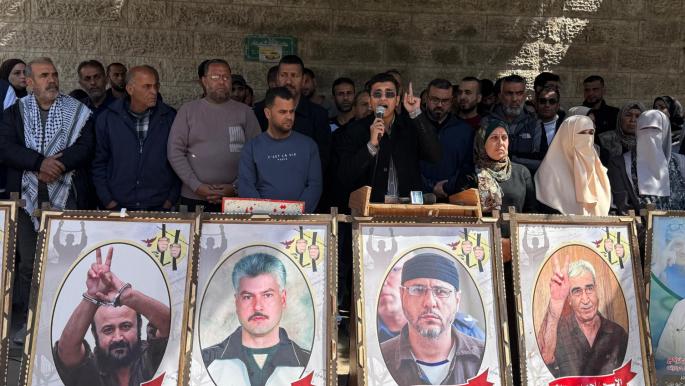
Families of prisoners in Gaza City organized an angry and massive protest today, Tuesday, against the execution law for prisoners approved by the Israeli Knesset. Participants in the event considered this law to be a blatant violation of international laws and human rights, reflecting the oppressive policies of the occupation against the Palestinian people.
The participants gathered in the Unknown Soldier Square in central Gaza, where they raised banners expressing their rejection of this law, demanding the international community intervene to stop these violations. Several released prisoners and representatives of Palestinian prisoner institutions participated in the event, emphasizing the necessity of solidarity with prisoners in the occupation's jails.
Details of the Event
This protest comes at a sensitive time, as Palestinian prisoners in Israeli jails face harsh conditions, including administrative detention, torture, and deprivation of their basic rights. Speakers at the event pointed out that the execution law poses a direct threat to the lives of many prisoners and exacerbates their suffering.
Participants also noted that this law contradicts international laws, including the Fourth Geneva Convention, which prohibits the execution of prisoners in armed conflicts. They considered this law a serious escalation in the occupation's policy towards Palestinians and stressed that it should be met with increased international pressure.
Background & Context
The execution law for prisoners is part of a series of laws enacted by the Israeli Knesset in recent years aimed at tightening penalties on Palestinians. This law was introduced amid rising tensions between Palestinians and Israelis, especially following recent events in the West Bank and Gaza Strip.
Historically, the Palestinian cause has witnessed numerous human rights violations, including arbitrary arrests and executions. This law has sparked widespread reactions from human rights organizations, which consider these policies a blatant violation of international laws.
Impact & Consequences
The execution law for prisoners is expected to have serious repercussions on the situation in the Palestinian territories, potentially leading to escalated confrontations between Palestinians and occupation forces. This law may also negatively affect peace efforts and increase frustration and despair among Palestinians.
Furthermore, international reactions to this law will be crucial. If the international community fails to pressure Israel to halt these policies, it could exacerbate the humanitarian situation in the Palestinian territories and increase the suffering of prisoners and their families.
Regional Significance
The Palestinian cause is a central issue in the Arab world, and any escalation in this context affects stability in the region. The enactment of the execution law for prisoners may provoke strong reactions from Arab countries and increase solidarity with the Palestinian cause.
This law may also impact relations between Israel and Arab countries, especially amid normalization efforts that some countries are seeking to achieve. The continuation of Israeli violations could bring the Palestinian cause back to the forefront of Arab and international attention.
In conclusion, the protest in Gaza today reflects the depth of suffering experienced by Palestinian prisoners and underscores the necessity of solidarity with them in the face of oppressive policies. The escalation in this context requires urgent international action to stop violations and protect human rights.