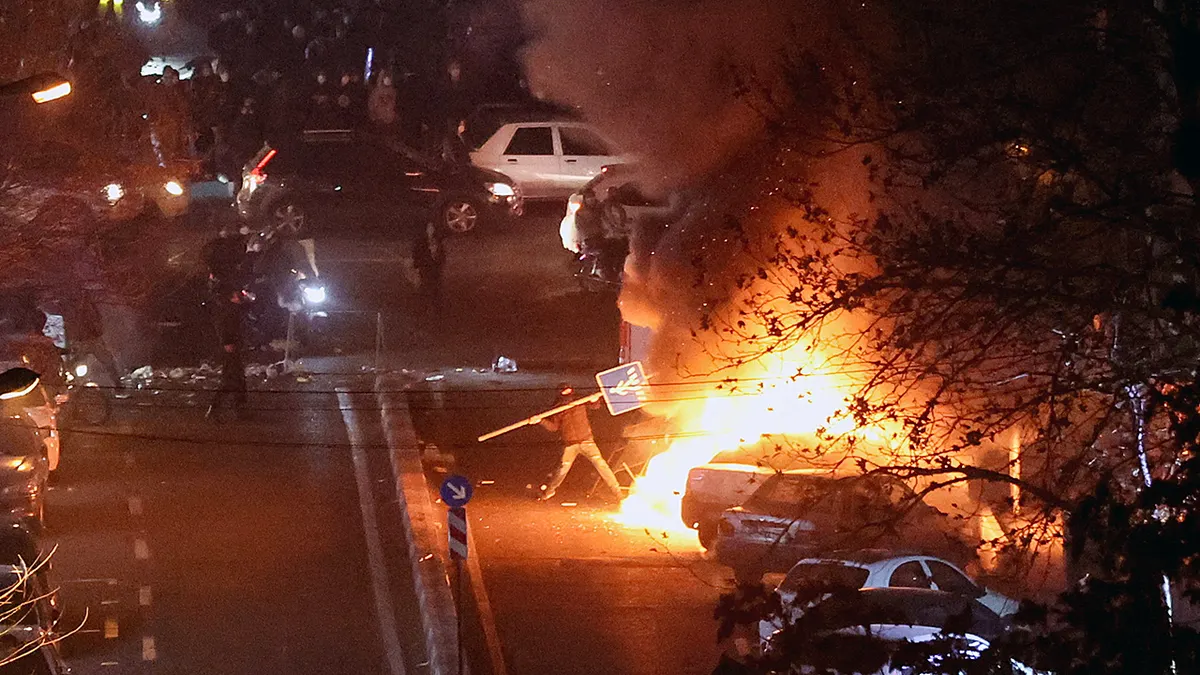
A number of Iranians gathered in 'Enqelab' Square in Tehran to protest against the temporary ceasefire announced between the United States and Iran, which also includes Israel. The demonstration witnessed a large turnout as protesters raised Iranian flags and images of the country's leaders, chanting slogans against the U.S. and Israel, expressing their dissatisfaction with the agreement.
These protests come at a sensitive time as the Iranian regime seeks to bolster its internal position amid external pressures. Images circulated on social media showed large crowds of demonstrators, reflecting public anger towards U.S. and Israeli policies in the region.
Details of the Event
The protesters gathered in 'Enqelab' Square, one of the most prominent squares in Tehran, known as a center for many popular protests. The square saw a heavy police presence, but this did not prevent demonstrators from freely expressing their opinions. Participants in the demonstration held banners calling for resistance against external pressures, emphasizing the need to maintain national sovereignty.
Some protesters pointed out that the temporary ceasefire represents an unacceptable concession by the Iranian government, calling for a tougher stance against the U.S. and Israel. The demonstration was punctuated by chants calling for national unity in the face of external challenges.
Background & Context
These protests coincide with rising tensions between Iran and the United States, especially following a series of events in the region in recent months. Iran believes that any agreement with the United States must ensure its national interests, while the U.S. views Iran as a threat to regional security.
In recent years, relations between Iran and the United States have deteriorated significantly, particularly after Washington's withdrawal from the nuclear agreement in 2018. These events have exacerbated economic and social conditions in Iran, leading to increased public protests.
Impact & Consequences
These demonstrations are seen as an indicator of political and social instability in Iran, as citizens express their dissatisfaction with government policies. These protests may impact the Iranian government's position in future negotiations with the United States, as the government may feel pressure from the street to adopt a more hardline stance.
Moreover, these events could exacerbate economic conditions in the country, where citizens are facing increasing economic pressures due to imposed sanctions. Such pressures may lead to further protests in the future, complicating the internal situation.
Regional Significance
These protests are part of the larger picture of tensions in the region, where relations between Iran and the United States affect many Arab countries. Arab nations are closely monitoring developments in Iran, as any escalation in tensions poses a threat to regional security.
The demonstrations also reflect a state of public discontent towards the foreign policies of major powers, which could lead to similar movements in other countries. Under these circumstances, the situation in the region remains fragile, with the potential for escalating tensions in the future.
In conclusion, these protests in Tehran reflect a state of public anger towards U.S. and Israeli policies, indicating significant challenges facing the Iranian government in maintaining its internal stability.