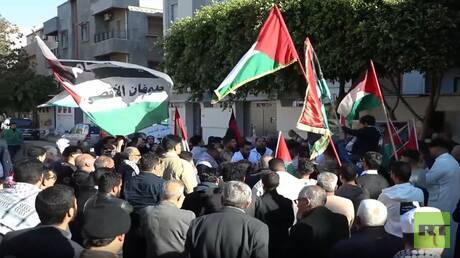
On Friday evening, citizens and activists gathered in front of the Palestinian Embassy in Tripoli, Libya, to protest against the law permitting the execution of Palestinian prisoners. This demonstration was part of their ongoing support for the Palestinian cause and solidarity with the Palestinian people in their struggle against occupation.
The protesters held banners expressing their rejection of laws that threaten the lives of prisoners and raised slogans calling for freedom and justice. Participants emphasized the importance of Arab unity in facing the challenges confronting the Palestinian people.
Details of the Event
The protesters gathered around the Palestinian embassy, where several activists delivered speeches about the suffering of prisoners in Israeli occupation jails. Speakers noted that the law allowing the execution of prisoners represents a blatant violation of human rights and reflects the oppressive policies of the occupation against Palestinians.
They also called on the international community to intervene to stop these violations, stressing the need to support the rights of the Palestinian people to self-determination. The demonstration saw a notable turnout from various segments of society, reflecting the Libyan people's concern for the Palestinian cause.
Background & Context
This protest comes at a sensitive time, as tensions in the occupied Palestinian territories are escalating, particularly following the recent surge in arrests and field executions. The law permitting the execution of prisoners has sparked outrage among Palestinians and Arabs, with many viewing it as part of the genocide policy pursued by the occupation.
Historically, the Palestinian cause has witnessed many difficult moments, with Palestinian prisoners subjected to various oppressive methods, including arbitrary detention and torture. Prisoners are seen as symbols of the Palestinian struggle, continuing to face challenges despite the harsh conditions they endure.
Impact & Consequences
The enactment of the law allowing the execution of prisoners could lead to heightened tensions in the occupied territories and increase the friction between Palestinians and the Israeli occupation. Furthermore, this law may negatively impact peace efforts in the region, as many observers believe that such policies hinder opportunities for dialogue and negotiation.
Moreover, international reactions to this law could be crucial, as this move is expected to provoke widespread criticism from human rights organizations and the international community. Such criticism could lead to pressure on the Israeli government to change its policies towards Palestinian prisoners.
Regional Significance
The Palestinian cause is central to the Arab world, where any violations against Palestinians evoke strong reactions in various Arab countries. This protest may help strengthen Arab solidarity with the Palestinian people and remind Arab nations of the necessity to support Palestinian rights.
Additionally, these events could stimulate further grassroots movements in Arab countries, where citizens seek to express their support for the Palestinian cause and reject Israeli policies. Arab solidarity with Palestine remains a fundamental element in confronting the occupation.
The protest in Tripoli reflects the Libyan people's commitment to the Palestinian cause and underscores the importance of Arab unity in facing challenges. Amid the rising violations against prisoners, hope remains pinned on the support of the international and Arab community to achieve justice and peace in the region.