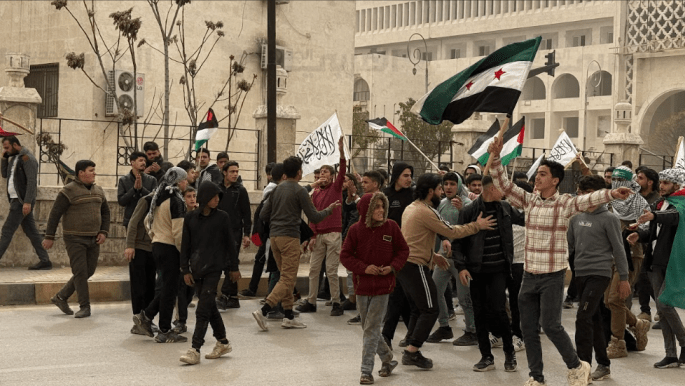
On Friday, several cities in Syria witnessed protests and demonstrations in solidarity with Palestinian prisoners in Israeli jails, responding to a law allowing their execution passed by the Israeli government. Protesters gathered in the streets of major cities such as Damascus and Aleppo, raising Palestinian flags and holding placards calling for support of prisoners' rights and demanding their release.
These demonstrations come at a sensitive time, as Palestinian prisoners face harsh conditions in Israeli prisons, increasing public discontent in the Arab world towards Israeli policies. Demonstrators expressed their strong rejection of the execution law, considering it a blatant violation of human rights.
Details of the Protests
The protests began in several Syrian provinces, where hundreds gathered in public squares, chanting slogans supporting the Palestinian cause. Some areas witnessed clashes with security forces attempting to disperse the protesters, resulting in injuries among demonstrators. Additionally, some participants in the protests were arrested, further fueling anger among the crowds.
These protests coincided with calls from international human rights organizations to condemn the execution law, as these organizations deemed the law contrary to international human rights standards. Several statements were issued urging the international community to take a firm stance against this law.
Background & Context
Historically, the issue of Palestinian prisoners has been a central focus in the Israeli-Palestinian conflict, with thousands of Palestinians suffering from detention in Israeli prisons. Recent years have seen an escalation in violations against prisoners, including torture and mistreatment. The execution law recently passed by the Israeli government comes amid a growing policy of repression against Palestinians.
This law, which allows for the execution of prisoners convicted of murder, has sparked outrage not only in Palestine but throughout the Arab world. Many view this law as an attempt to intimidate Palestinians and silence their calls for freedom and justice.
Impact & Consequences
These protests in Syria represent an expression of Arab solidarity with the Palestinian cause and may increase pressure on Arab governments to adopt stronger positions against Israeli occupation. Furthermore, these events could affect relations between Arab countries and Israel, as tensions are likely to escalate in the coming period.
Moreover, these protests may bolster popular movements in Arab countries, as citizens seek to express their support for the Palestinian cause. This reflects a shift in public awareness regarding human rights in the region and emphasizes the importance of the Palestinian issue in Arab discourse.
Regional Significance
The Palestinian issue is one of the central issues in the Arab world and directly affects relations between Arab countries. The escalation of protests in Syria may inspire other countries in the region to take similar steps, potentially increasing pressure on Arab governments to engage more seriously with the Palestinian cause.
Additionally, these events may contribute to strengthening Arab solidarity, as citizens feel they are part of a larger cause related to freedom and justice. Given the current circumstances, these protests could be an opportunity to renew momentum towards supporting the Palestinian cause in international forums.
In conclusion, the issue of Palestinian prisoners remains at the heart of the Israeli-Palestinian conflict, and the ongoing protests in Syria serve as a testament to Arab solidarity. The escalation in this context requires an effective response from the international community to ensure human rights and protect prisoners in Israeli jails.