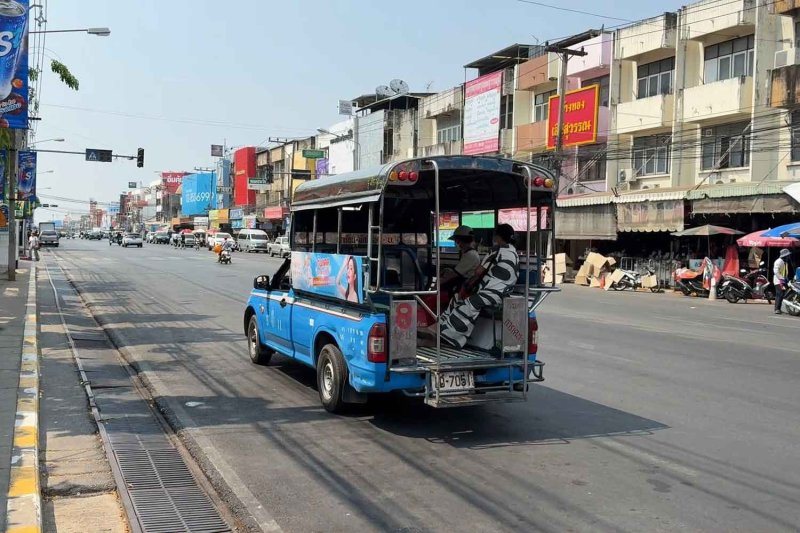
Public transport drivers in Thailand have announced a one-day strike in protest against the increasing fuel prices that threaten their income and negatively affect transport services. This action comes at a time when the country is suffering from a sharp decline in tourist numbers, adding to the pressures on workers in this sector.
In Phuket, leaders of the "Yellow-Red" taxi group announced that over 4,000 drivers, including taxis and buses, are ready to participate in the strike. Wati Vasana Rongrong, the group's leader, explained that "fuel prices rise every day, and we only earn 100-200 baht daily. We cannot continue this way."
Details of the Strike
Wati pointed out that transport services relying on smart applications contribute to lowering prices, while tourist numbers have dropped by as much as 70%, exacerbating the financial situation for drivers. The drivers also plan to organize a large gathering to present a petition to the Phuket governor, demanding stricter oversight on illegal vehicles and fair price regulation. Wati added, "If we cannot survive, how can we continue to serve others?"
In Khon Kaen, the increase in diesel prices, which approached 50 baht per liter, has led to a reduction in public transport services. The "Songthaew" services have cut back on trips, leaving passengers with fewer options. A 65-year-old driver, Daing, noted that the fare remains fixed at 11 baht despite the rising costs associated with the war in the Middle East, suggesting an increase in fare to 13 baht.
Background & Context
Historically, the public transport sector in Thailand has faced significant challenges due to fluctuations in fuel prices, which directly impact drivers' income. With the increasing reliance on smart applications for transport services, drivers are facing intense competition, further increasing their financial pressures. In recent years, the country has also seen a decline in tourist numbers due to global crises, negatively affecting the local economy.
In Nakhon Ratchasima, inter-provincial bus operators have reported ongoing losses. Chaiwat Wongpinjarat, the general manager of "Nakhon Chai 21," stated that rising diesel prices severely affect operators. The Central Land Transport Committee has approved a fare increase of 5 satang per kilometer, allowing licensed operators to raise prices starting Monday, with the government compensating the difference.
Impact & Consequences
Estimates suggest that the increase in fuel prices could significantly reduce public transport services, causing major disruptions for passengers. Chaiwat confirmed that "every trip is still incurring losses," noting that fuel prices have risen by 17 baht per liter in recent increments, far exceeding the fare increase. He explained that operators lack sufficient liquidity to cover daily fuel costs, warning that if diesel prices continue to rise, services will be severely affected.
During the "Songkran" holiday, trips are expected to be lower than usual as operators await government support. Chaiwat emphasized, "Support must come quickly; otherwise, operators will not survive," warning that delays could lead to minimal service reductions, causing significant disruptions for passengers.
Regional Significance
The fuel price crisis and its impact on public transport is a relevant issue for many Arab countries, which face similar challenges amid rising energy prices. Many nations are suffering from negative economic impacts due to oil price fluctuations, affecting living standards and public services. Additionally, the decline in tourist numbers in some Arab countries due to global crises reflects challenges similar to those faced by Thailand.
In conclusion, the current protests by public transport drivers in Thailand reflect a larger economic crisis that requires urgent government response to ensure the sustainability of transport services and protect the income of workers in this sector.