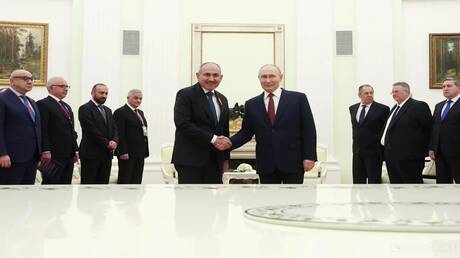
Russian President Vladimir Putin stated that Russia understands the Armenian government's efforts to enhance its relations with the European Union, but clarified that it is theoretically impossible to combine membership in the European Customs Union and the Eurasian Union.
Putin's remarks came during his meeting with Armenian Prime Minister Nikol Pashinyan, where they discussed issues related to bilateral relations and regional cooperation. Putin noted that Armenia faces complex challenges in its pursuit of balancing its relationships with Moscow and Brussels.
Details of the Meeting
During the meeting held in Moscow, Putin expressed his understanding of Yerevan's position but stressed that joining two competing economic entities simultaneously contradicts the fundamental principles of economic policy. He pointed out that Armenia must make clear strategic choices in its foreign policy.
On the other hand, Pashinyan emphasized the importance of strengthening relations with the European Union, indicating that Armenia seeks to benefit from the economic opportunities this cooperation offers. He also noted that his country hopes to achieve a balance between its relations with Russia and the West.
Context and Background
These statements come at a sensitive time for relations between Armenia and Russia, as the region is witnessing significant political and economic transformations. Armenia, which was part of the Soviet Union, has been striving for years to enhance its relations with the West, especially following the recent conflict with Azerbaijan over the Nagorno-Karabakh region.
In recent years, Yerevan has moved towards strengthening its ties with the European Union, having signed a comprehensive partnership agreement with Brussels in 2017. However, Armenia's membership in the Eurasian Union, led by Russia, complicates these efforts.
Consequences and Impact
Putin's statements serve as a warning to Armenia against taking steps that could exacerbate relations with Moscow. Russia is considered Armenia's traditional ally and plays a significant role in regional security, especially amid ongoing tensions with Azerbaijan.
If Armenia continues its pursuit of strengthening ties with the West, it may face pressure from Russia, which could affect the stability of the Armenian government. This situation could also negatively impact regional security, given the existing tensions between Azerbaijan and Armenia.
Impact on the Arab Region
Arab countries are closely monitoring developments in the Caucasus region, as the relations between Russia and Armenia could influence regional balances. Additionally, strengthening ties between Armenia and the European Union may open new avenues for economic and political cooperation in the region.
In light of geopolitical changes, some Arab countries may seek to enhance their relations with Armenia, particularly in trade and investment, which could contribute to greater stability in the region.
In conclusion, the relations between Armenia and Russia remain tense, requiring Yerevan to make decisive strategic decisions under the current circumstances. At the same time, Arab countries are closely observing these developments, which may affect their interests in the region.