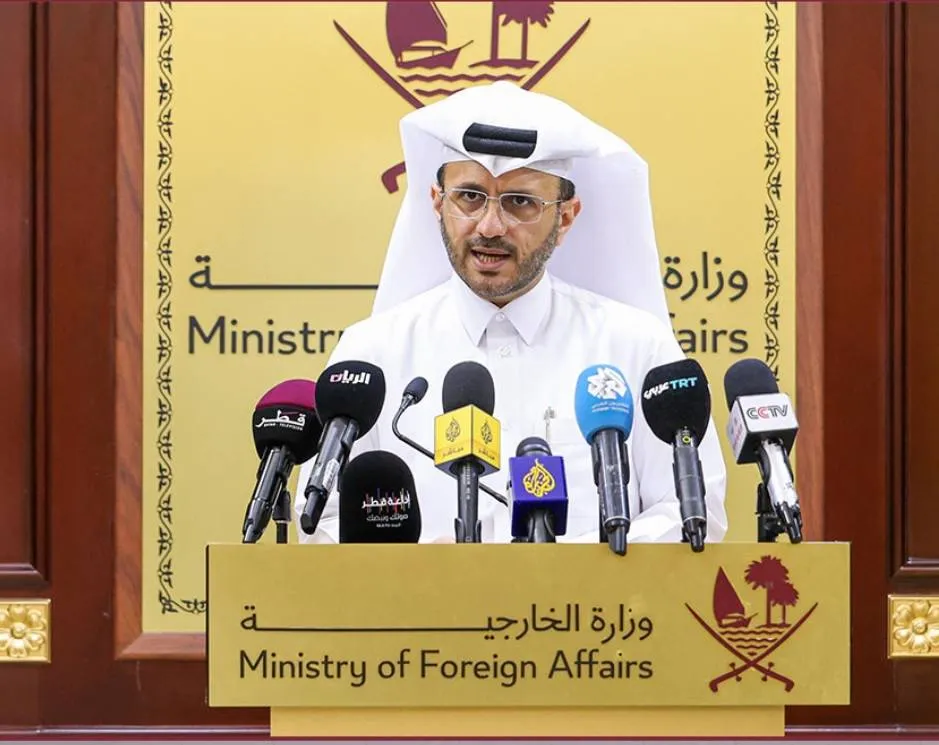
The Qatari Foreign Ministry has confirmed that recent Iranian attacks have significantly crossed many red lines, warning of the implications of continued escalation on the region's security and stability. The ministry stressed the necessity of adhering to international law and protecting vital installations.
During a press briefing, Majid Al-Ansari, spokesperson for the Qatari Foreign Ministry, called for de-escalation in the region, indicating that ongoing tensions would not benefit anyone but would lead to further losses. He welcomed diplomatic initiatives aimed at calming the situation, affirming that approaching the negotiation table is the optimal solution for achieving stability in the region.
Details of the Situation
Regarding Lebanon, Al-Ansari emphasized the importance of respecting the state's sovereignty, noting that Israeli attacks and incursions represent a clear violation of international law. He revealed that coordination is ongoing with international parties to contain the escalation in Lebanon.
On the Iranian issue, the spokesperson confirmed that Qatar opposes targeting vital and civilian installations, stressing that striking energy facilities represents a serious breach of red lines. He explained that Qatar has filed complaints with international organizations regarding Iranian aggressions, while affirming that Iran is a neighboring country and that a mechanism for coexistence must be established.
Background & Context
These statements come at a time when the region is witnessing increasing military escalation, as Iranian attacks on Gulf countries pose a significant challenge to regional security. Recent events have shown that tensions in the region directly affect security and stability, necessitating a response from all concerned parties.
Al-Ansari also addressed the issue of the Strait of Hormuz, describing it as a regional matter with global implications. He warned that any threat or closure of the strait poses a risk to energy security and international supply chains. He confirmed that Doha is working with its international partners to ensure navigation security, calling for regional consensus on managing this issue.
Impact & Consequences
Concerns are growing that continued escalation could lead to dire consequences for regional and international security. Earlier, the UAE Ministry of Defense confirmed that the country's air defense systems are countering missile and drone attacks coming from Iran, reflecting the rising tensions in the region.
Saudi air defenses also announced their success in repelling a series of attacks targeting the Riyadh area, demonstrating the armed forces' readiness to face increasing threats. These events indicate that the region may be on the brink of larger military escalation if the situation is not contained swiftly.
Regional Significance
These developments directly affect Arab countries, placing them in a sensitive position that requires coordinated efforts to enhance security and stability. Saudi Crown Prince Mohammed bin Salman, Jordanian King Abdullah II, and Qatari Emir Sheikh Tamim bin Hamad discussed regional developments during a trilateral meeting in Jeddah, reflecting the importance of cooperation among Arab countries to face common challenges.
In conclusion, hope remains pinned on diplomatic efforts to achieve peace in the region, as any further escalation could lead to severe consequences for regional and international security.