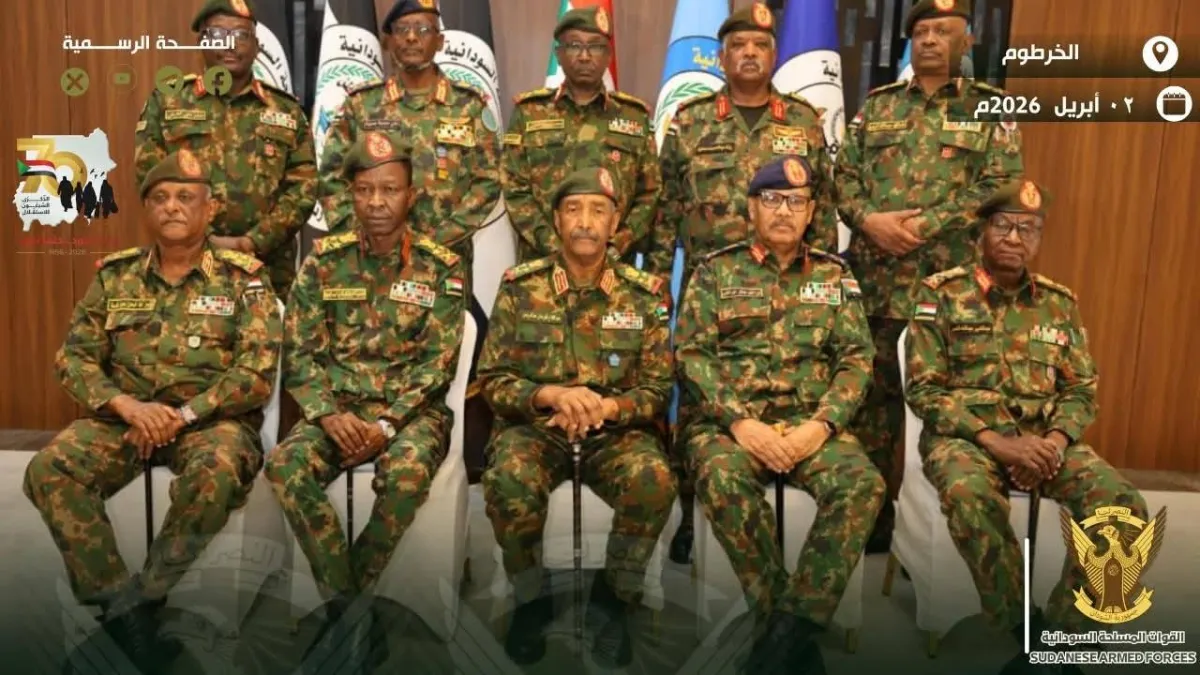
On Monday, the Chairman of the Transitional Sovereignty Council and Commander-in-Chief of the Sudanese Army, Abdel Fattah al-Burhan, issued a decision to revoke decision number 164 of 2023, which had appointed the Deputy Chief of Staff and his assistants. This decision comes at a sensitive time for the Sudanese army, as the country is experiencing increasing military tensions.
Lieutenant General Shams al-Din Kabbashi held the position of Deputy Chief of Staff, while Lieutenant General Yasir al-Atta and Lieutenant General Ibrahim Jabir served as assistants to the Commander-in-Chief. However, the new decision stipulates that these leaders will remain as members of the Armed Forces Leadership Council, indicating their continued role in the military institution despite the changes.
Details of the Decision
This move follows days after the appointment of Yasir al-Atta as Chairman of the Army Staff, reflecting strategic changes in military leadership. Al-Burhan also issued a decision to appoint new assistants to the Commander-in-Chief, with Lieutenant General Shams al-Din Kabbashi appointed as Assistant for Construction and Strategic Planning, Lieutenant General Mirghani Idris Suleiman Idris as Assistant for Military Industries, and Lieutenant General Ibrahim Jabir as Assistant for International Relations and Military Cooperation.
These changes are among the most significant in the Sudanese army and the Sovereignty Council since the outbreak of war between the army and the Rapid Support Forces in April 2023, reflecting the urgent need to restructure military leadership amid the current circumstances.
Background & Context
Historically, the Sudanese army has witnessed numerous changes in its leadership, especially following the ousting of Omar al-Bashir's regime in 2019. Since then, the country has faced significant challenges, including internal conflicts and tensions between various military factions. These changes are part of Al-Burhan's efforts to consolidate his authority and unify ranks in the face of security challenges.
These events coincide with escalating conflicts between the army and the Rapid Support Forces, exacerbating the humanitarian and political situation in the country. These conflicts have significantly impacted Sudan's stability, necessitating urgent measures to rebuild trust between the armed forces and civil society.
Impact & Consequences
These changes are expected to influence military and political dynamics in Sudan. The restructuring of military leadership may enhance coordination among the armed forces, contributing to improved responses to security crises. However, these changes may also raise concerns among some political and military factions, who may view them as an attempt to dominate power.
Additionally, these steps could impact Sudan's international relations, as neighboring countries and the international community look towards stability in the country. If handled correctly, these changes could improve Sudan's image on the international stage.
Regional Significance
The situation in Sudan is of great importance to the Arab region, as Sudan's stability directly affects regional security. Amid current tensions, these changes may present an opportunity to enhance cooperation among Arab countries in security and development fields.
Furthermore, these steps may encourage other Arab countries to reconsider their security strategies, especially in light of the common challenges facing the region, such as terrorism and irregular migration.
In conclusion, Al-Burhan's decision to dismiss the Deputy Chief of Staff and his assistants reflects strategic changes in the Sudanese army and comes at a critical time that necessitates a reevaluation of military and security policies. The new leadership must work to enhance stability and build trust with civil society to ensure a better future for Sudan.