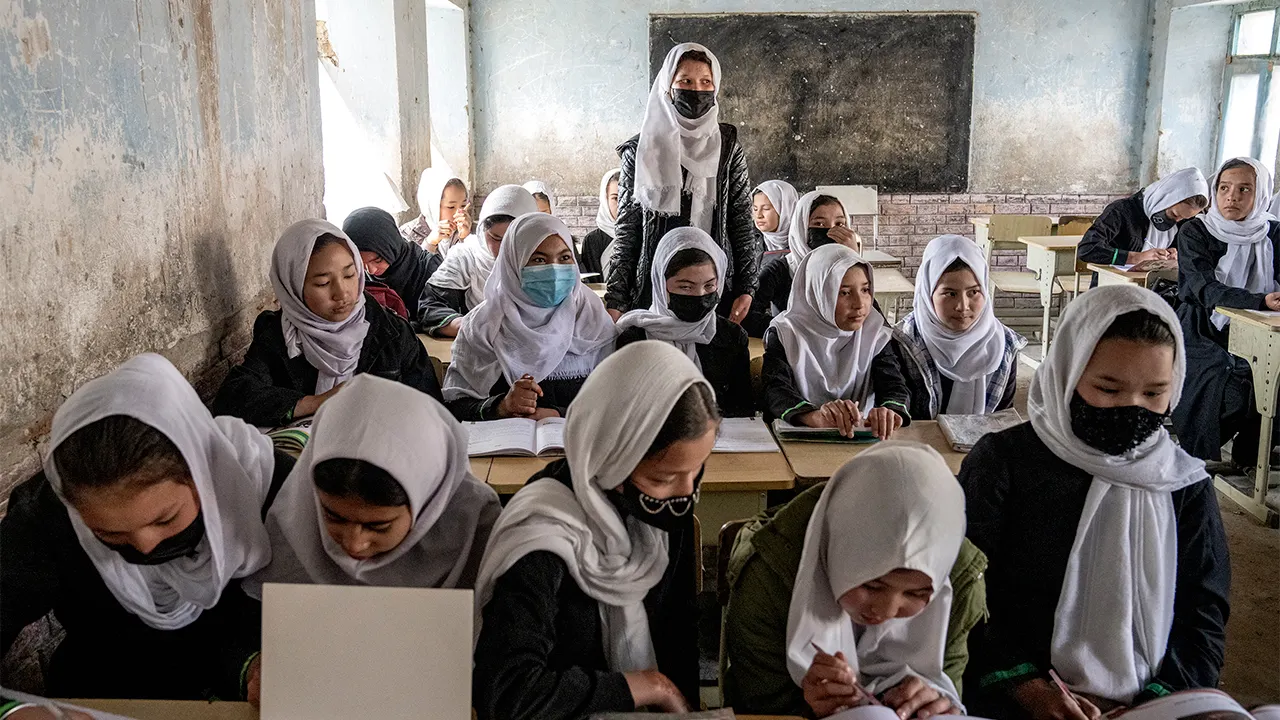
As the bell rings to signal the start of the new school year in Afghanistan, life returns to the schoolyards in the capital, Kabul, and other cities, where thousands of students flow into their classrooms, carrying their bags and hopes. However, this scene appears incomplete once again, with a near-total absence of girls.
In one neighborhood of Kabul, Zareen Azimi wakes up to the sound of a school bell near her home, but it no longer signifies the start of a school day for her; instead, it awakens memories and postponed dreams. Zareen stands behind her window watching young girls head to school while she has remained at home for years, waiting for a decision that will restore her right to learn.
Details of the Event
With the start of the school year in mid-March 2026, schools opened their doors to male students and girls in elementary grades, but girls in grades six and above remain outside the classrooms, continuing a ban imposed since March 2022. This reality reflects not only an educational measure but also a daily issue experienced by thousands of Afghan families, where feelings of hope at the beginning of each school year are mixed with repeated disappointment for girls waiting to return to their schools, while the gap between what is available to them and what they aspire to widens.
Salma Azizi, a mother of three girls, tells Al Jazeera Net that her daughter Nida has dreamed since childhood of becoming a doctor to help patients and alleviate their pain, spending long hours studying science and small medical books that she could access. She adds that feelings of helplessness and despair have begun to overwhelm her daughter after years of the ban, as she wonders about her future and whether she will ever be able to continue her education, explaining that the family waits each year for a decision to reopen schools with no new developments, while the dreams of girls gradually fade away.
Context and Background
On the other hand, female teachers confirm that the continued deprivation of girls from education negatively impacts even the lower grades, where frustration begins to seep into the souls of students early on. Fatima Al-Zahra, a teacher at a private school in Kabul, tells Al Jazeera Net that elementary school girls feel frustrated when they realize they will not be able to continue their education, which affects their interest in studying from the start.
This reality places families and society before a dual challenge; while parents strive to provide an educational environment for their children, teenage girls remain deprived of attending school, widening the educational gap between genders and deepening the effects of social and economic marginalization, according to parents. During the inauguration ceremonies of the new school year, the stance of government officials was clear on some matters, while they avoided discussing others.
Consequences and Impact
The Afghan Ministry of Education stated in remarks to Al Jazeera Net that the priorities for the year include curriculum preparation, teacher training, and providing a "healthy and balanced" educational environment, without mentioning the reopening of secondary schools for girls above grade six. In this context, Noor Haq Anwar, head of the administrative affairs office in the Afghan government, explained in an interview with Al Jazeera Net that previous curricula were "imported from abroad and did not meet local needs," pointing to efforts to prepare a new curriculum that aligns with these needs, without providing a timeline for reopening schools for girls.
Data from the ministry, which Al Jazeera Net obtained, showed that the school year plan focuses on administrative aspects and developing the education sector, such as reactivating inactive schools, organizing exams, and establishing night schools, while there are no indications of changes in policies regarding girls' education at the secondary level. International data indicates that the education sector in Afghanistan faces a deep, multidimensional crisis, and according to the United Nations Educational, Scientific and Cultural Organization (UNESCO) and the United Nations Children's Fund (UNICEF), approximately 2.2 million girls have been deprived of secondary education since the Taliban returned to power in 2021, placing the country in a globally exceptional situation regarding the deprivation of a large segment of girls from education.
Impact on the Arab Region
At the same time, a UNICEF report reveals that more than 2.13 million children of primary school age are out of school, while over 90% of ten-year-old children suffer from weak basic reading and writing skills, reflecting a crisis that goes beyond the issue of excluding girls. Previous statistics from 2021 indicate that the literacy rate was around 37%, with a clear disparity between males and females, illustrating that the educational gap existed before it was exacerbated by recent policies, as the majority of teenage girls spend their time on household chores or assisting their families, reducing their chances of receiving any alternative education.
International human rights organizations have repeatedly called for the reopening of schools for girls, emphasizing that education is the foundation of dignity and future opportunities. Sanjay V. Jaiswal, UNICEF's regional director for South Asia, stated that the time has come for girls to return to school, stressing that hope, dignity, and the future begin with education.
Moreover, the UNICEF representative in Afghanistan emphasized on a post on "X" platform the right of every girl to education, considering that educating girls contributes to strengthening communities and building the future of the country. For her part, rights activist Rubina Azizi expressed her concern over the continued ban on girls' education, explaining in her talk with Al Jazeera Net that this decision does not merely represent an educational measure but a blatant violation of a fundamental right, as it limits girls' capabilities and constrains their future opportunities, deepening social gaps and increasing marginalization.
She added that depriving girls of education creates a generation with limited capabilities and places society before significant developmental challenges, especially in health, education, and economic sectors, stressing the need for local and international communities to pressure for the reopening of schools, as any delay in this matter harms not only girls but undermines the future of the entire Afghan society.