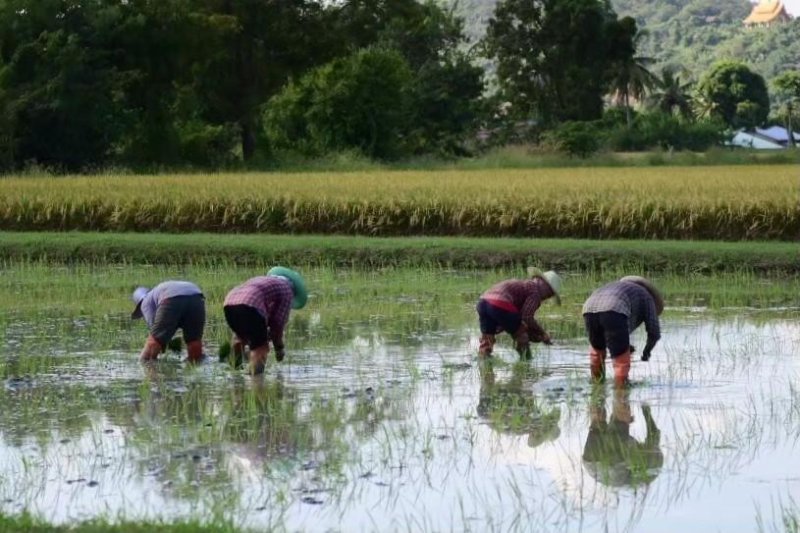
In a recent statement, Inno Sui Suwan, a member of Thailand's National Economic and Social Development Council, revealed that Thai agriculture will remain ensnared in a cycle of debt unless the government implements new policies. He emphasized that the ongoing reliance on cash assistance and deferring debt repayments will not resolve the fundamental issues faced by farmers.
Sui Suwan, who previously served as the president of the Agricultural and Agricultural Cooperatives Bank, explained that the policies adopted by successive governments have not addressed the root causes of the problem but have merely provided temporary solutions. When farmers suffer production losses, the government compensates them or offers financial support, akin to administering painkillers without treating the underlying illness.
Details of Current Support Programs
For instance, the government offers a program that grants rice farmers 1,000 Thai Baht per rai, but this support is limited to 10 rai per household. According to Sui Suwan, such measures do not fundamentally address the issue but rather perpetuate dependence on government support.
In contrast, he pointed out that Vietnam has successfully reformed its agricultural sector through a policy of "3 reductions and 3 increases," which reduced the use of seeds, fertilizers, and chemicals while increasing profits, farmer health, and environmental quality.
Background & Context
Historically, most farmers in Thailand rely on cultivating cash crops such as rice, cassava, rubber, and corn, which the government promotes for export. However, the high production costs of these crops leave farmers vulnerable to fluctuations in global market prices.
Thailand is among the top five producers of these crops, but the intensive use of chemicals and burning methods adversely affects soil quality. When farmers lack capital, they turn to the Agricultural Bank as a borrowing mechanism, leading to a cycle of debt that is difficult to escape.
Impact & Consequences
Sui Suwan reported that approximately 50% of farmers remain under debt suspension measures throughout their lives, reflecting their inability to repay what they owe. Additionally, the maximum debt eligible for suspension has increased from 100,000 Baht to 200,000 Baht, further entrenching reliance on these measures.
He noted that the government borrows from the Agricultural Bank to fund farmer support programs, but these funds remain unpaid, placing the bank in a precarious financial position. Therefore, the government must adopt appropriate policies instead of relying on assistance or freezing debts.
Regional Significance
This issue is pivotal in improving the economic situation of farmers and enhancing agricultural sustainability in Thailand. The current reliance on temporary measures not only fails to resolve the underlying problems but also risks long-term economic stability for the agricultural sector.
In conclusion, a comprehensive overhaul of agricultural policies is essential for Thailand to break free from the cycle of debt and foster a more sustainable and resilient agricultural economy.