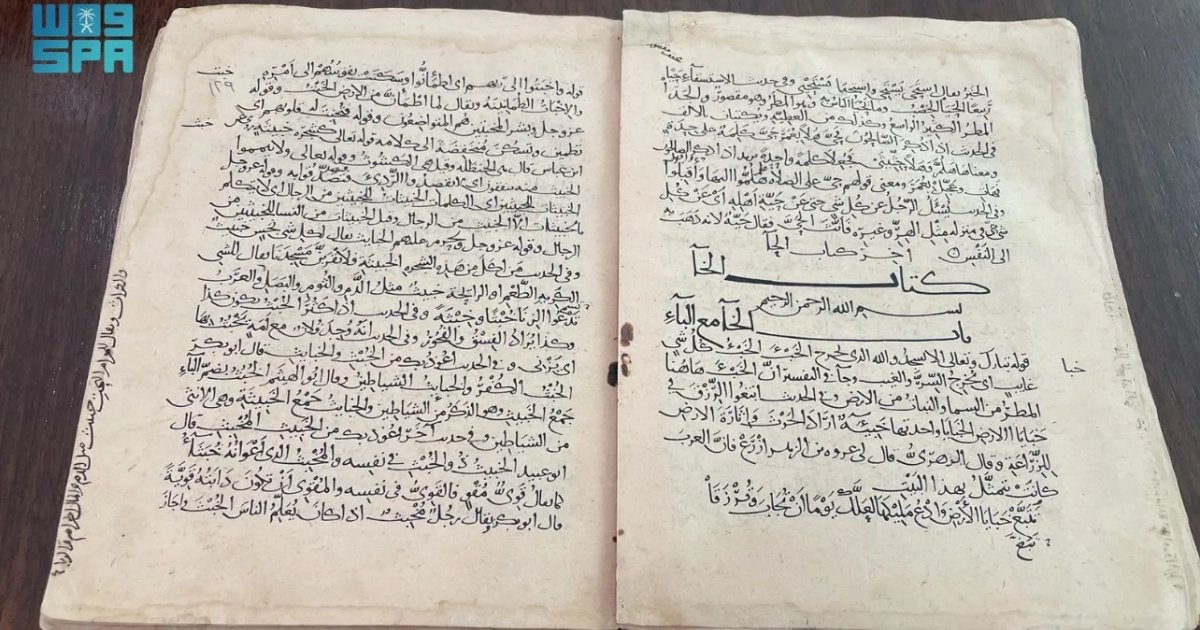
The King Abdulaziz Public Library in Riyadh has unveiled a rare manuscript of the Holy Quran titled 'Gharib Al-Quran', which dates back over 1000 years. This manuscript, written by the prominent scholar Abu Ubaidah Ma'mar ibn al-Muthanna, belongs to the 4th century AH and consists of 23 pages measuring 17 x 22 cm. The manuscript is distinguished by its clear Andalusian script, with the names of the chapters inscribed in Kufic script.
This manuscript is part of a diverse and rare collection of manuscripts related to the interpretation of the Holy Quran, which the library preserves. This collection also includes other works such as 'I'raab Al-Quran wa Ma'anihi' by Abu Ishaq Al-Zajjaj, written in the 5th century AH, and 'Taweel Mushkil Al-Quran' by Ibn Qutaybah Al-Dinuri, a manuscript copied in the 7th century AH.
Event Details
The King Abdulaziz Public Library aims to enhance cultural and religious awareness among the public by showcasing these rare manuscripts. The library holds over 185 rare manuscripts related to the interpretation of the Quran, in addition to hundreds of other manuscripts covering various fields of Quranic sciences, including grammar, linguistic analysis, and verse interpretation. These manuscripts are classified into four main areas: interpretation, readings and Tajweed, Quranic sciences, and Quranic manuscripts.
Among the manuscripts in the field of interpretation, we find 'Lubab Al-Taweel fi Ma'ani Al-Tanzil', 'Al-Taysir fi Al-Tafsir' by Umar Al-Nasafi, 'Hal Al-Ishkalat fi Fahm Ba'd Al-Ayat' (12th century AH / 17th century CE), 'Al-Bahr Al-Madeed fi Tafsir Al-Quran Al-Majeed' by Ahmad ibn Ajibah, and 'Ma'alim Al-Tanzil' by Al-Baghawi, among other valuable works.
Background & Context
The significance of these manuscripts lies in their representation of the cultural and religious heritage of the Islamic world, reflecting the scholarly efforts made by Muslim scholars to understand and interpret the Holy Quran. The manuscripts are rich sources of information on how Quranic sciences have evolved over the ages, contributing to a deeper understanding of religious texts.
Historically, Islamic manuscripts have been considered one of the most important means of transmitting knowledge and have contributed to shaping Islamic thought throughout the ages. Public libraries like the King Abdulaziz Library play a vital role in preserving this heritage and passing it on to future generations.
Impact & Consequences
Highlighting these rare manuscripts reflects the Kingdom of Saudi Arabia's commitment to preserving cultural and religious heritage, enhancing its status as a center of knowledge and science in the Islamic world. Additionally, showcasing these manuscripts encourages researchers and enthusiasts to study Quranic sciences more deeply, contributing to the development of academic research in this field.
This step also serves as an invitation for the public to engage with cultural heritage, thereby enhancing Islamic identity and encouraging the study of religious texts in new and innovative ways.
Regional Significance
The importance of these manuscripts transcends the borders of the Kingdom, as they represent part of the cultural and religious heritage of the Arab and Islamic world. Preserving and showcasing these manuscripts enhances cultural cooperation among Arab countries and encourages the exchange of knowledge and expertise in the field of Islamic studies.
In light of the challenges facing the region, promoting religious and cultural understanding through these manuscripts is an important step towards fostering peace and tolerance among peoples.