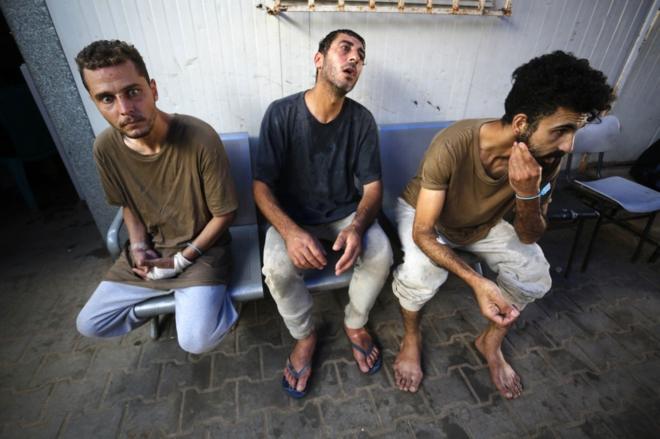
Palestinian prisoners released from Israeli jails recount harrowing experiences of systematic torture, including sleep deprivation and starvation. Their testimonies highlight the inhumane conditions faced by detainees in these facilities.
In the courtyard of Al-Aqsa Martyrs Hospital in Deir al-Balah, released prisoner Ashraf Muhammad Zamaqaat, who endured a harsh experience in ‘Sde Teiman’ prison, known among Palestinians as the 'graveyard of the living,' struggled to find words to describe his 55 days of captivity. He was abducted from Khan Younis and found himself in an unbearable hell.
Details of the Torture
Zamaqaat described daily torture that exceeds human endurance, noting that prisoners cried out to their Creator at every moment while lacking the most basic necessities of life. He mentioned that physical torture and constant exhaustion were the norm, while sleep deprivation was the most brutal method, as they were only allowed to close their eyes for three hours a day.
Testimonies from released prisoners reflect a systematic policy followed by the occupation authorities against Gaza detainees, where prisoners suffer from malnutrition and severe cold, all in the complete absence of any international oversight. Al-Aqsa Martyrs Hospital received two batches of released prisoners, with 30 detainees suffering from deteriorating health and psychological conditions.
Background & Context
Stories from Palestinian prisoners released from Israeli occupation jails paint a grim picture of the reality faced by detainees who have become victims of physical and psychological abuse. The Euro-Mediterranean Human Rights Monitor revealed that the method known as “white torture,” which relies on sleep deprivation, represents a blatant violation of human rights and aims to break human will.
Lawyer Mervat Al-Nahal from the Al-Mezan Center for Human Rights confirmed that the occupation's prisons have turned into arenas for systematic revenge, where methods of torture are employed that go beyond individual cases, threatening the psychological well-being of prisoners.
Impact & Consequences
The suffering of prisoners extends beyond the physical aspect to include enforced disappearance, as the occupation authorities deliberately conceal information about the fate of thousands of prisoners, leaving their families in a state of constant anxiety. Human rights reports confirm that there are over 10,000 Palestinians, including women and children, facing similar conditions inside prisons.
With each new batch of released prisoners, new chapters of tragedy unfold, as the detainees emerge in tattered clothing and frail bodies, reflecting the magnitude of the crimes committed against them. These testimonies underscore the urgent need for accountability for the ongoing violations by the occupation.
Regional Significance
These events highlight the dire humanitarian conditions faced by Palestinians under occupation, necessitating urgent international action to protect the rights of prisoners. The continuation of these violations reflects the occupation's disregard for international laws, placing the international community before its responsibilities regarding the Palestinian cause.
In conclusion, the issue of Palestinian prisoners remains a bleeding wound in the heart of the larger humanitarian cause, requiring everyone to stand by them and support them in their plight.