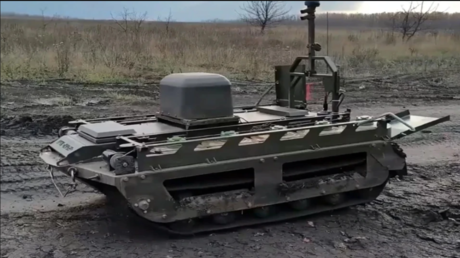
Russia has announced modifications to its military 'Courier' robot, transforming it into a mobile ground station for controlling drones. This initiative aims to enhance Russia's military capabilities in the field of unmanned aerial vehicles, reflecting a growing trend towards the use of modern technology in military operations.
The 'Courier' robot is one of Russia's military innovations developed to meet the needs of the armed forces. With the new modifications, this robot can control a range of drones, thereby enhancing the effectiveness of military operations and enabling Russian forces to execute their missions more efficiently.
Details of the Development
The modifications made to the 'Courier' robot include the addition of advanced control systems, allowing it to interact directly with drones. These systems incorporate sophisticated communication and navigation technologies, enabling the robot to control aircraft from long distances. The robot's maneuverability and adaptability to various environmental conditions have also been improved, increasing its effectiveness in the field.
These developments come at a time when the global military landscape is witnessing increased competition in the use of drones. Many countries are striving to enhance their capabilities in this area, making it essential for Russia to bolster its technological capabilities to meet new challenges.
Background & Context
Historically, Russia has been one of the leading countries in developing military technology, but it has faced significant challenges in recent years due to Western sanctions and rapid technological advancements. Therefore, the development of the 'Courier' robot and its transformation into a drone control platform is a strategic step aimed at enhancing Russian military capabilities.
In recent years, Russia has seen an increase in its investments in military research and development, focusing on the use of modern technologies such as artificial intelligence and robotics. These investments are part of a strategic vision aimed at enhancing Russian national security and expanding its military influence in conflict areas.
Impact & Consequences
These developments could lead to a shift in the military balance of power in the region. With the increased use of drones in military operations, Russia may become more capable of executing complex operations without the need to deploy large ground forces. This could alter the strategies of other countries in dealing with military threats.
Moreover, the use of the 'Courier' robot as a platform for controlling drones may encourage other countries to develop similar technologies, increasing the arms race in the field of unmanned aerial vehicles. This could exacerbate military tensions in conflict areas, especially in the Middle East and Eastern Europe.
Regional Significance
In the Arab region, developments in Russian military technology could have a significant impact on ongoing conflicts. Countries facing security challenges may seek to enhance their military capabilities by importing Russian technology or developing similar local programs. This could lead to increased military tensions in the region, particularly amid ongoing conflicts in Syria, Libya, and Yemen.
Additionally, the use of drones in military operations could change the nature of warfare in the region, as they can be employed for reconnaissance and precision strikes, complicating the military landscape further.
In conclusion, the development of the 'Courier' robot into a platform for controlling drones reflects a growing trend towards the use of technology in military operations. This step could lead to significant changes in the military balance of power, not only in Russia but also in the Arab region and globally.