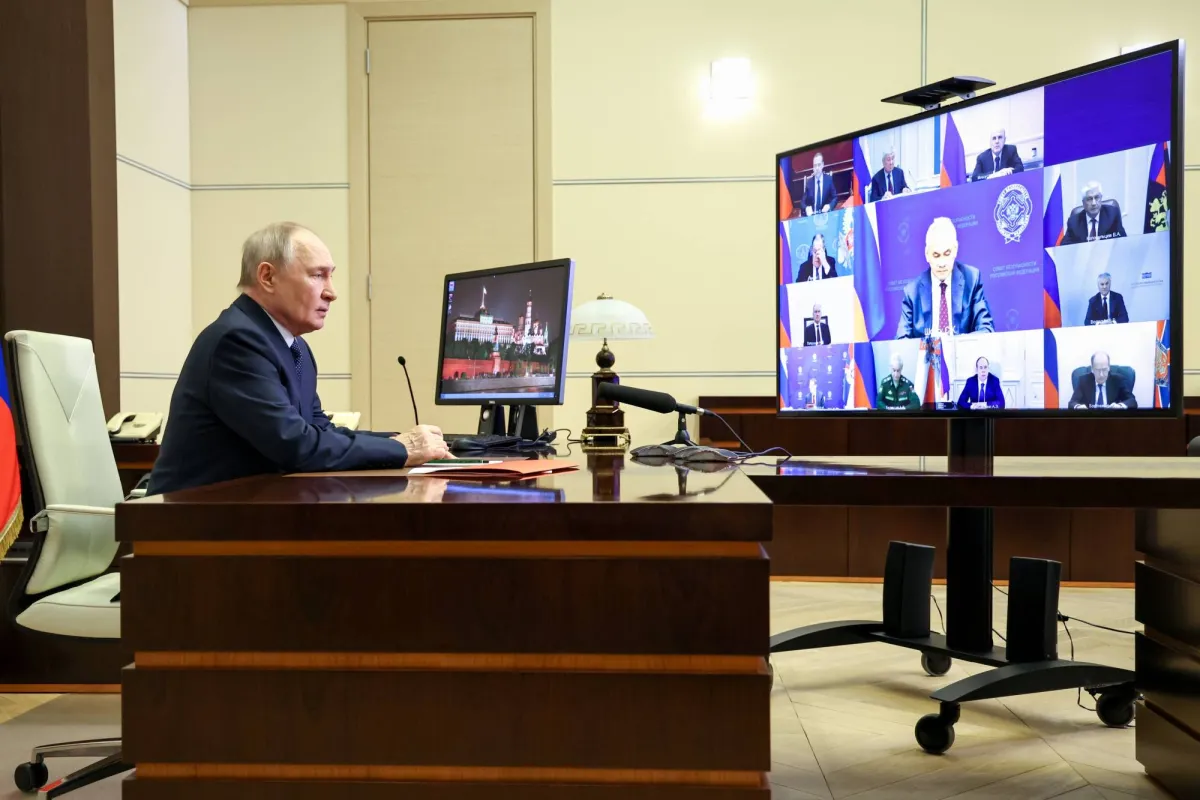
Russia has issued a warning regarding the "escalation of confrontation and the expansion of war" in the Middle East, indicating that "the entire region is on the verge of igniting." This statement comes as Beijing confirmed its willingness to collaborate with Moscow at the United Nations Security Council to reduce tensions and maintain peace.
Although Kremlin spokesperson Dmitry Peskov avoided directly commenting on the warning issued by U.S. President Donald Trump to Tehran, his tone reflected a level of Russian concern regarding the intensifying conflict.
Details of the Situation
Peskov stated during a press briefing on Monday that Moscow has "taken note of the U.S. President's statements regarding the Strait of Hormuz and prefers not to comment on them." Trump had threatened Iran that Tuesday would be a "day of bridges and power stations," calling for the reopening of the Strait of Hormuz, or else the Iranians would "live in hell." The Russian Foreign Ministry warned that "the language of threats does not succeed with the Iranians," suggesting that the Kremlin's stance on Trump's warning appeared more cautious.
Peskov added that Russia had warned, even before hostilities broke out in Iran, of the dire consequences of launching aggression. He emphasized that the repercussions on the global economy would be inevitable, noting that "tensions in the Middle East are escalating due to the conflict over Iran."
Background & Context
These warnings come at a time when the region is witnessing an increase in hostilities, with the conflict surrounding Iran expanding. Peskov pointed out that "the entire region is nearly ablaze," cautioning against the negative consequences of aggression towards Iran.
In a related context, it seems that Moscow and Beijing are working to coordinate their positions regarding developments in the Middle East. Russian Foreign Minister Sergey Lavrov and Chinese Foreign Minister Wang Yi discussed the situation in the Middle East during a phone call, reporting that they agreed to continue their joint coordination.
Impact & Consequences
Concerns are rising that the current escalations could lead to a broader conflict in the region, significantly impacting the global economy. Peskov warned that "the consequences we face are extremely severe for the global economy," pointing out that the situation poses a grave risk to energy supply lines.
He also noted that various parts of the gas infrastructure have previously been subjected to attacks, complicating the situation further. It appears that Russia is taking on a mediating role in an attempt to de-escalate tensions.
Regional Significance
These developments are particularly significant for Arab countries, as they may lead to destabilization in the region. The increasing tensions between major powers could affect regional security, prompting Arab nations to adopt cautious stances.
At the same time, the coordination efforts between Russia and China may enhance cooperation between the two countries, potentially altering the balance of power in the region. Consequently, Arab nations must be prepared to face any potential repercussions.
In conclusion, amid escalating tensions in the Middle East, Russia and China remain in a strong position, reflecting the importance of international cooperation in addressing crises. It remains to be seen how events will unfold in the coming days.