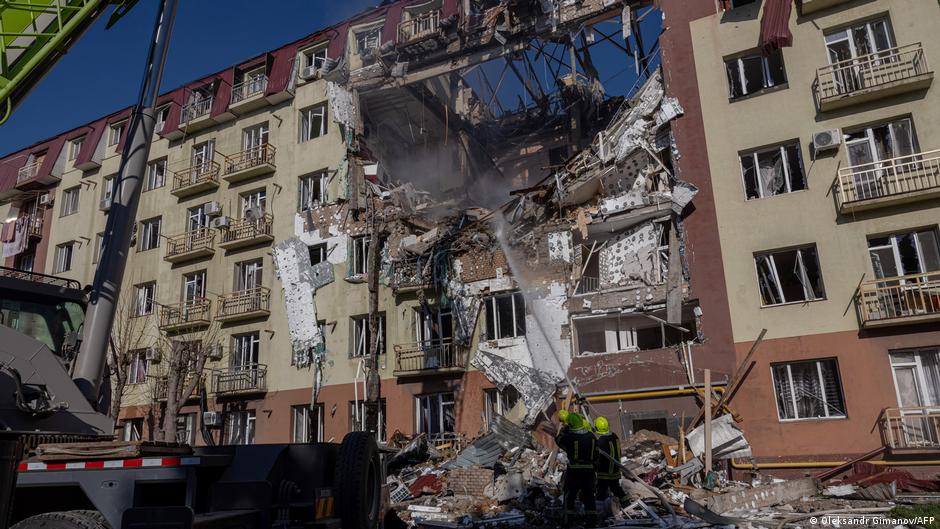
The drone strikes carried out by Russian forces on the Ukrainian city of Odessa in the early hours of Monday resulted in the deaths of three people, including a woman in her thirties and her two-year-old daughter. Additionally, 15 others sustained injuries, according to local authorities.
The attack targeted a multi-story residential building, where the regional military governor, Oleksandr Kiper, confirmed that law enforcement agencies are working to document the crimes committed by the aggressor state against civilians. He noted that residential buildings and critical infrastructure suffered significant damage, and rescue operations are ongoing as it is believed that there are individuals trapped under the rubble.
Details of the Attack
According to Ukrainian air defense forces, Russia launched its latest attack using 141 drones, of which 114 were intercepted. Simultaneously, the northern Chernihiv region experienced several strikes, leading to power outages affecting approximately 340,000 people.
In a related context, Ukrainian President Volodymyr Zelensky urged his country's partners to enhance air defense capabilities, emphasizing the need to increase the interception rate of drones and missiles. He also added that Russia has no intention of halting its invasion of Ukraine, which has now entered its fifth year.
Background & Context
The war between Ukraine and Russia has been ongoing since 2019, with recent years witnessing an escalation in mutual attacks. These events coincide with peace efforts led by the United States, which have been partially hindered by the conflict in the Middle East.
Ukraine is seeking to carry out counter-attacks on Russian oil facilities, particularly in light of the increased demand for Russian oil due to reduced supplies from the Middle East as a result of the current war between the United States, Israel, and Iran.
Impact & Consequences
The attacks on Russian oil facilities are viewed as a strategic move by Ukraine to disrupt Russia's ability to capitalize on rising oil prices. The Institute for the Study of War in Washington indicated that the damage to energy infrastructure will cost Russia significant time and money to repair.
At the same time, Zelensky warned that Russia is economically benefiting from the war in Iran, as it receives additional funds due to the easing of U.S. sanctions on Russian oil.
Regional Significance
The events in Ukraine directly impact the Arab region, especially amid the current tensions in the Middle East. The continuation of the war in Ukraine could lead to an increase in global oil prices, affecting the economies of Arab countries that heavily rely on oil exports.
In conclusion, the situation in Ukraine remains tense, with ongoing mutual attacks between the two sides. These circumstances require close monitoring by the international community, especially in light of the economic and political challenges facing the region.