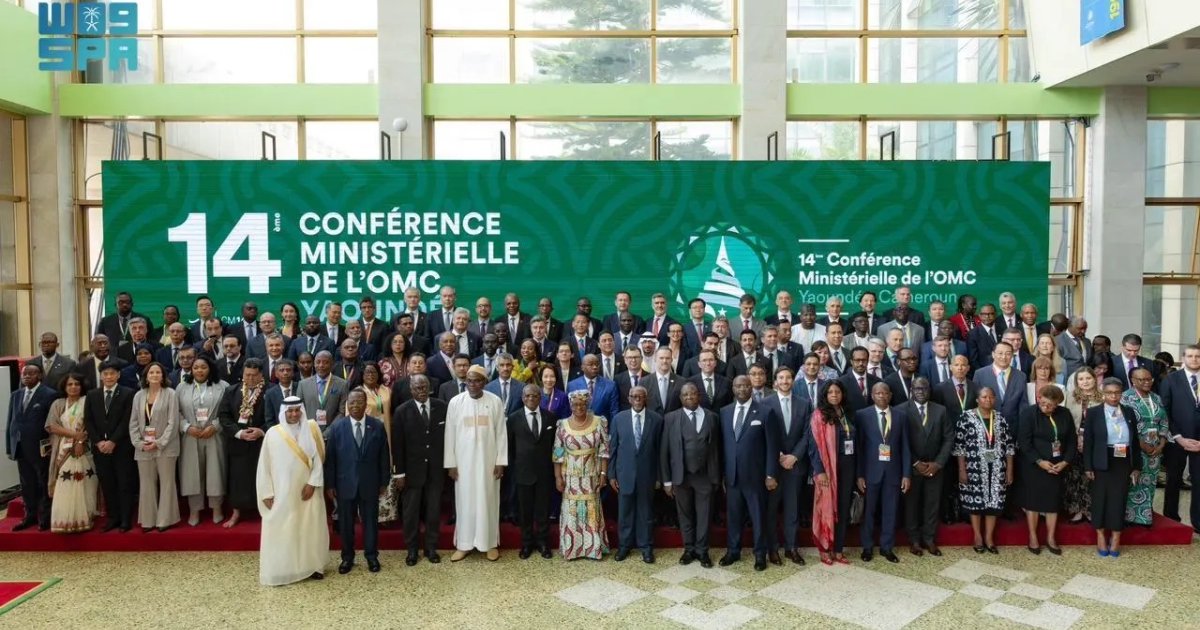
The 14th Ministerial Conference of the World Trade Organization (WTO) concluded in Yaoundé, Cameroon, on Sunday, where the Saudi delegation, headed by Farid Al-Assali, Deputy Governor of the General Authority for Foreign Trade, emphasized the Kingdom's full support for reform efforts within the organization.
During his speech at the conference, Al-Assali highlighted the importance of enhancing dispute resolution and improving food security for developing countries, stressing the need for special and differential treatment for least developed and developing nations. He also pointed out the necessity of expediting the accession processes for countries to the organization, which would contribute to their integration into global trade and value chains.
Conference Highlights and Discussions
The conference addressed a range of significant topics, including WTO reform, agricultural issues, fisheries, development concerns, and matters related to least developed countries. Additionally, the e-commerce work program was discussed, along with the inclusion of an investment facilitation agreement for development, as well as the extension of exemptions related to trade measures concerning intellectual property.
On the sidelines of the conference, Al-Assali met with several international ministers, including New Zealand's Minister of Trade, Investment, and Agriculture, Todd McClay, Ethiopia's Minister of Trade and Regional Integration, Dr. Kasahun Gofe, Ethiopian State Minister for Foreign Affairs, Hadera Abera Admasu, and Austria's Deputy Minister of Economy, Energy, and Tourism, Dr. Stefan Gruber.
Background & Context
The WTO was established in 1995 with the aim of promoting global trade by facilitating negotiations on trade agreements and providing a platform for dispute resolution among member states. Saudi Arabia is an active member of the organization, with its trade volume with member countries reaching approximately $537 billion, while its exports amounted to around $305 billion in 2024.
Through its support for reform efforts, Saudi Arabia aims to enhance its role in the global economy, especially in light of the challenges faced by developing countries in trade and development. The Kingdom is also working towards achieving the goals of Vision 2030, which aims to diversify the economy and enhance foreign investments.
Impact & Consequences
The reform efforts within the WTO are of great significance, as they can contribute to improving the global trade environment and facilitating access to markets. Saudi Arabia's support for these efforts reflects its commitment to enhancing international cooperation and achieving sustainable development.
Moreover, improving food security for developing countries is a vital issue, especially amid increasing global crises. These efforts can help bolster economic and social stability in those nations, positively impacting the global economy as a whole.
Regional Significance
These developments present an opportunity for Arab countries to enhance their trade and economic cooperation, particularly in light of the challenges facing the region. Saudi Arabia's support for reforms in the WTO can serve as a model for other Arab nations in promoting economic integration.
Furthermore, enhancing e-commerce and facilitating trade procedures can open new horizons for Arab countries in attracting investments and achieving sustainable development.