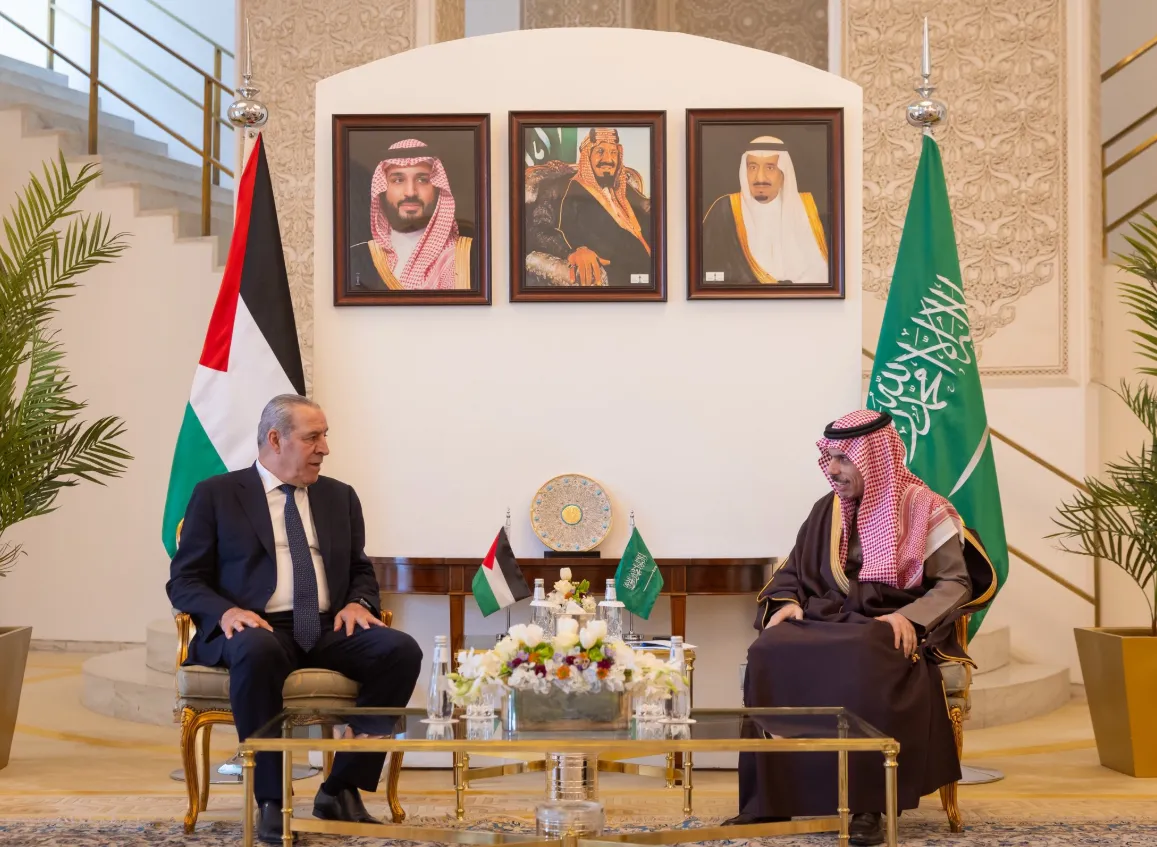
Saudi Foreign Minister Prince Faisal bin Farhan engaged in discussions with Hussein Sheikh, Deputy Head of the Palestinian Liberation Organization's Executive Committee, regarding the latest developments in the Gaza Strip and the West Bank. The meeting, which took place in Riyadh, aimed to explore ways to strengthen cooperation between the two sides while also addressing regional conditions and the efforts being made to manage them.
Also present at the meeting was the Minister of Foreign Affairs' Political Advisor, Prince Musab bin Mohammed Al Farhan, highlighting Saudi Arabia's deep commitment to the Palestinian cause and the importance of coordination between the two parties amidst the current circumstances.
Details of the Meeting
This dialogue comes at a sensitive time for the Palestinian territories, where tensions are escalating in both the Gaza Strip and the West Bank. Saudi Arabia, which maintains close ties with Palestine, has expressed its unwavering support for Palestinian rights, emphasizing the importance of a peaceful resolution to the conflict.
In a related context, Saudi Arabia strongly condemned the Iranian attacks targeting a camp belonging to the Kuwaiti Armed Forces, which resulted in injuries to several individuals. Riyadh affirmed that these assaults reflect a hostile behavior from Iran towards regional countries, exacerbating existing tensions.
Background & Context
Historically, Saudi Arabia has been one of the most prominent supporters of the Palestinian cause, striving to promote Palestinian rights in the face of Israeli occupation. The relationship between Saudi Arabia and Palestine has seen notable developments in recent years, particularly with the rising tensions in the region.
The Iranian attacks on Kuwait are part of an increasing escalation from Tehran, raising concerns about a larger regional escalation. This situation necessitates greater coordination among Arab states to confront shared threats.
Impact & Consequences
These developments underscore the urgent need for Arab unity in addressing security and political challenges. Coordination between Saudi Arabia and Palestine could enhance the Arab position in international forums and improve the chances of achieving peace in the region.
Moreover, the Iranian escalation may lead to heightened tensions in the Gulf, prompting a swift response from Arab nations to safeguard their national security. Collaborative Arab efforts could be key to avoiding further escalation.
Regional Significance
The Arab region is significantly affected by developments in Gaza and the West Bank, as the Palestinian issue remains a central theme in the Arab-Israeli conflict. Any escalation in this context could impact stability in neighboring countries and increase tensions.
In conclusion, hope remains pinned on diplomatic efforts to achieve peace and stability in the region, as coordination among Arab states is a fundamental step towards confronting shared challenges.