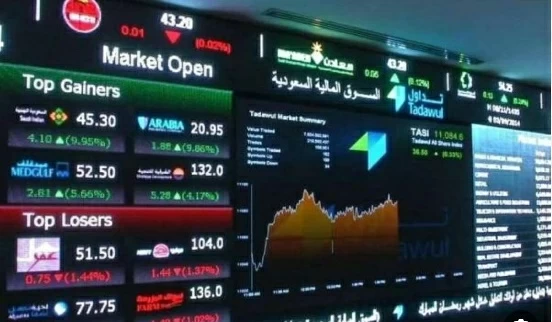
The Saudi stock market experienced notable movements today, with the parallel stock market index (Nomo) rising by 32.65 points, reaching a level of 22,751.82 points. This increase occurred alongside trading valued at 20 million riyals, with a trading volume exceeding 2.5 million shares.
Conversely, the main Saudi stock index closed down by 13.93 points, settling at 11,076.40 points, with trades amounting to 3.7 billion riyals. According to the daily economic bulletin from the Saudi Press Agency, the total number of shares traded reached 199 million shares, with 150 companies recording an increase in their stock values, while 107 companies saw their shares decline.
Event Details
Among the companies that saw an increase in their stock values, shares of Saleh Al-Rashed, Bawan, Anam Holding, Al-Jamiah for Sports, and Al-Rajhi Takaful topped the list. In contrast, shares of Gulf Training, Al-Saqr Insurance, Al-Masafi, Construction Station, and Emmar experienced the most significant declines.
The percentage increases and decreases ranged between 9.99% and 4.52%, reflecting market volatility. Additionally, shares of Americana, Batak, Anabeeb, Petro Rabigh, and Saudi Aramco were the most active in terms of volume, while Saudi Aramco, Al-Rajhi, SABIC Agricultural Nutrients, Saleh Al-Rashed, and Al-Ahli were the most active in terms of value.
Background & Context
The Saudi stock market is considered one of the largest financial markets in the region, playing a crucial role in attracting both local and foreign investments. Recently, the market has experienced significant fluctuations due to global and local economic changes, impacting the performance of many companies.
The Saudi government aims to strengthen the national economy through Vision 2030, which seeks to diversify income sources and reduce dependence on oil. This direction reflects the importance of the financial market in achieving economic goals.
Impact & Consequences
Movements in the financial market directly affect the Saudi economy, reflecting company performance and investor expectations. The rise in the 'Nomo' index may indicate increased confidence in small and medium-sized enterprises, while the decline in the main index could reflect challenges facing larger companies.
These movements serve as indicators of future economic trends and may influence the decisions of investors and analysts in the market, necessitating close monitoring of economic and political changes.
Regional Significance
The Saudi financial market is pivotal in the Arab region, with its movements influencing other markets. Amid global economic challenges, the Saudi market remains a focal point for investors, enhancing its status as an investment destination.
Many Arab countries seek to benefit from the Saudi experience in developing their financial markets, reflecting the importance of economic cooperation among Arab nations.
In conclusion, the Saudi stock market remains under scrutiny, as investors look to understand future trends amid global and local economic changes.