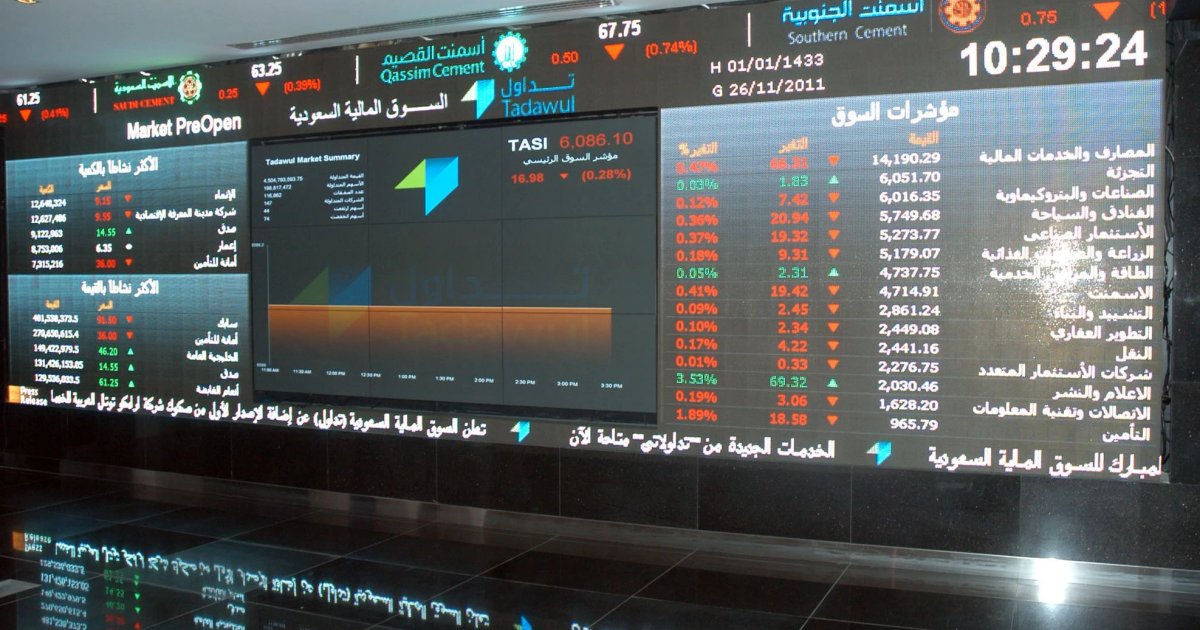
The Saudi stock market experienced a significant decline today, with its main index dropping by 175.08 points, settling at 11,087.54 points. The market recorded trading volumes amounting to 5.7 billion riyals, with 287 million shares exchanged during the session.
In the details of the trading session, shares of 14 companies saw an increase in value, while 249 companies faced declines. The stocks of companies such as CGS, Shams, Al-Mamlakah, Avalon Pharma, and Jamjoom Pharma were among the highest gainers, whereas shares of Al-Dawaa, Al-Masafi, Tabuk Agricultural, Research and Media, and Al-Fakheria saw the most significant losses.
Trading Session Details
The rise and fall percentages ranged between 6.10% and 7.64%, with shares of Americana, Saudi Aramco, Export, Batak, and Saudi Kayan being the most active in terms of volume. Meanwhile, Saudi Aramco, Al-Rajhi, Ma'aden, SABIC, and STC were the most active in terms of value.
The parallel market index, NOMU, also closed lower today, dropping by 249.92 points to reach 22,288.87 points, with trading valued at 29 million riyals, and the volume of shares traded exceeding two million shares.
Background & Context
This decline in the Saudi stock index comes at a time when global markets are experiencing notable volatility due to various economic and political factors affecting investor confidence. Recently, the Saudi market had shown significant activity, making this drop raise questions about the future of the market and the performance of listed companies.
The Saudi financial market is considered one of the largest in the region and plays a crucial role in attracting foreign investments. However, sudden price changes can impact investor decisions and sentiments.
Impact & Consequences
This decline is expected to affect investor sentiment, potentially leading to further pressure on stocks in upcoming sessions. Additionally, the drop in stock values may negatively impact companies' expansion and investment plans, affecting overall economic growth.
At the same time, these changes could present an opportunity for investors looking to buy stocks at lower prices, which may lead to a market recovery in the near future if economic conditions stabilize.
Regional Significance
The Saudi market is a major driver of the Arab economy, and any changes within it could influence financial markets in other Gulf countries. Therefore, investors in the region are closely monitoring developments in the Saudi market, as these changes can affect regional investment flows.
In conclusion, the biggest challenge facing the Saudi market remains the restoration of investor confidence and the need to enhance stability amid changing economic conditions.