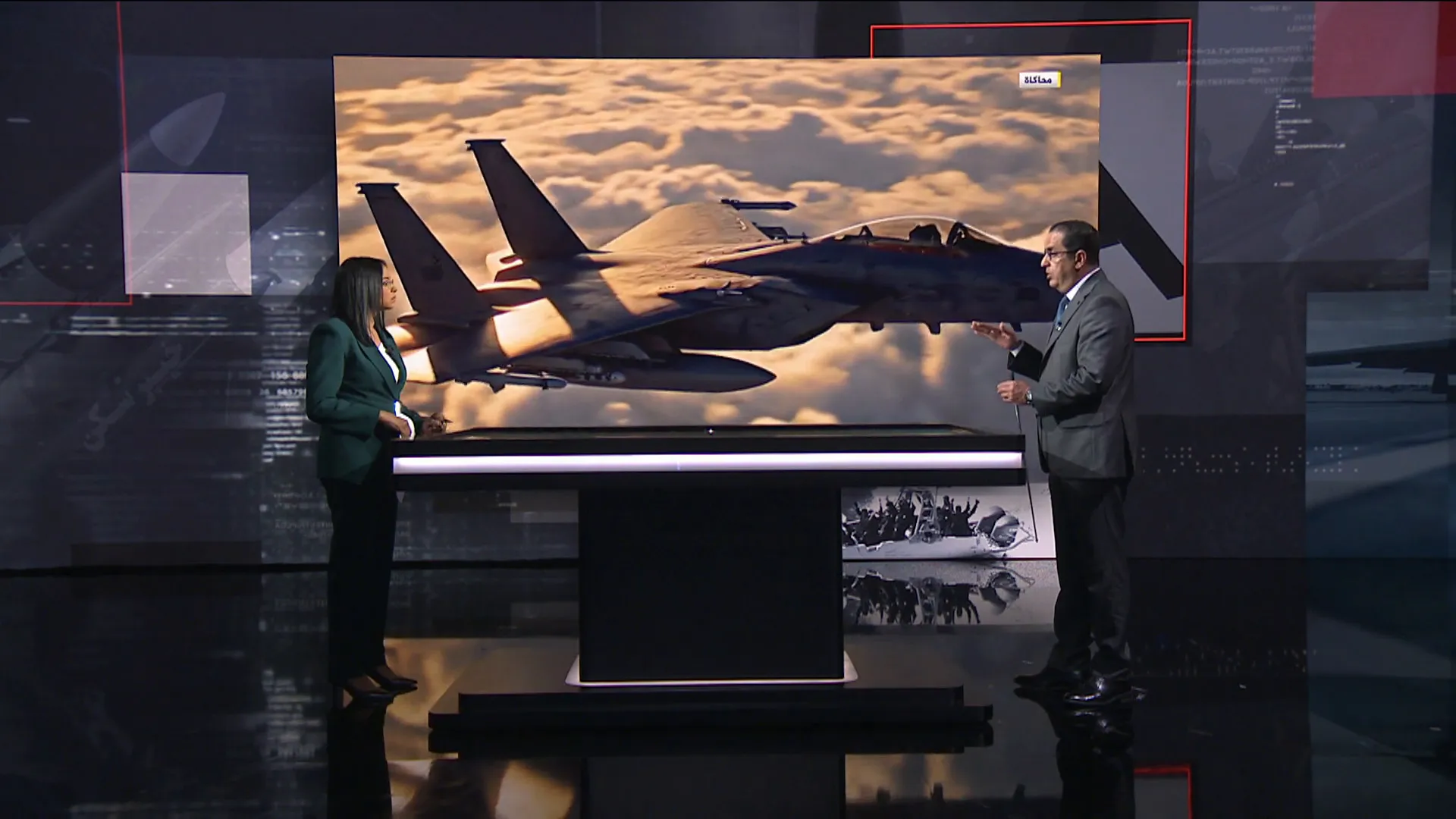
The military complexities surrounding the incident of two American fighter jets being shot down in Iranian airspace have deepened, placing the search for the missing pilot at the heart of a military confrontation where geographical calculations intertwine with aerial tactics. Reports indicate that the United States has lost a number of manned aircraft since the onset of the war, while a rescue operation successfully retrieved one pilot from a recently downed F-15 fighter jet, leaving the fate of another pilot uncertain amidst conflicting narratives.
Field data shows that the downing of an F-15 in Khuzestan province and another A-10 near Qeshm Island reflects a qualitative escalation in Iranian defenses' ability to target American aircraft in areas that were traditionally considered relatively safe. The crash site of the first aircraft lies within a broad geographical range extending between Khuzestan and Kohgiluyeh and Boyer-Ahmad provinces, near strategic locations such as Khorramshahr and Khark Island, increasing the sensitivity of the search and rescue operation.
Details of the Incident
Information suggests that the downing of the aircraft was not an isolated incident but part of a military tactic known as "air ambushes," where enemy aircraft are lured into specific air corridors and then targeted from unexpected angles using concealed detection and launch systems. This tactic reflects Iran's ability to exploit geographical terrain, as the Zagros Mountains provide an ideal environment for masking conventional radars, allowing for the deployment of air defense systems at altitudes that grant them a tactical advantage.
These operations overlap with the Iraqi borders, making any aerial or ground movement in the area susceptible to monitoring and targeting, complicating rescue operations. In this context, military expert Colonel Nidal Abu Zaid noted that the downing of three aircraft, including a Black Hawk rescue helicopter, represents a "heavy aerial toll" for the American side, indicating a shift from the concept of "air sovereignty" to "limited air control."
Background & Context
Concerns are rising that the targeting of the F-15 fighter jet, despite its near-stealth characteristics, may indicate the use of detection systems relying on infrared and optical imaging, bolstering the hypothesis of the limited introduction of advanced systems, possibly of Chinese origin. This shift raises questions about the nature of the tactics employed, as conventional missiles like 358 lack the speed necessary to intercept these aircraft, reinforcing the theory of the use of more advanced systems.
Following the aircraft's injury, the pilot activates the emergency system linked to the ejection seat, which sends immediate signals to satellites, triggering search and rescue teams according to a precise protocol that includes evasion and avoidance of capture. However, the mountainous nature of western Iran, particularly the expanse of the Zagros Mountains, provides a complex environment that enhances hiding opportunities, yet complicates monitoring and rescue operations.
Impact & Consequences
The field map indicates a pattern of intense American bombing extending from the crash sites through Mahshahr and Khorramshahr to the Shalamcheh crossing, in a connected path likely tracking the movement of the missing pilot, in an attempt to secure a safe rescue corridor. Additionally, the targeting of the Shalamcheh crossing, which Iraq announced had halted movement, reflects the connection between aerial operations and cutting supply lines or constraining any potential movements in the vicinity of the search area.
Simultaneously, an Israeli escalation has emerged in targeting petrochemical facilities within Iran, with strikes hitting sites in Mahshahr and Bushehr, indicating a shift in operations from "degradation" to "disruption" of industrial infrastructure. Abu Zaid believes that the focus on these facilities is linked to their role in producing fuel used in missiles, making them a strategic target to disrupt Iranian capabilities.
Regional Significance
The inclusion of the crash area in the "target bank" represents a notable shift, as this area was not previously targeted due to its status as an air corridor. However, Iran's exploitation of its geography and transformation into a site for "air ambushes" has imposed a new equation. Wars are not measured by isolated events but by the totality of interactions, where the decisive factor remains the "battle of time," meaning each party's ability to manage its resources and exhaust its opponent within an open, multi-dimensional conflict.
In conclusion, these events underscore the importance of understanding the complex military dynamics in the region and their impact on regional and international security, necessitating close monitoring by relevant stakeholders.