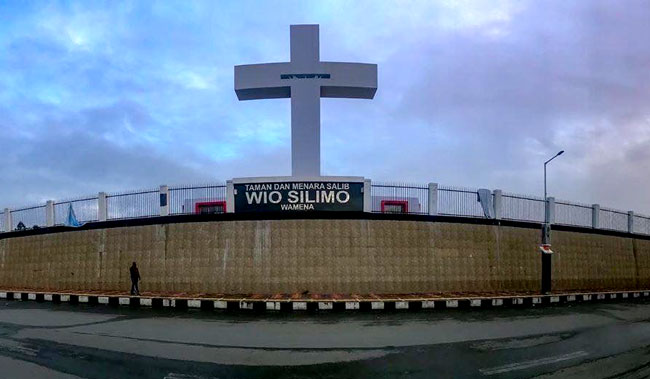
Wamena, located in the Indonesian province of Papua, is an important government center situated at an altitude between 1600 and 1800 meters above sea level. The city is renowned for its diverse cultural traditions, preserved by the indigenous people over generations, making it a unique destination.
The city embraces a variety of customs and traditions that reflect the rich cultural identity of the region, where residents live in harmony with nature. The people of Wamena are known for their strong adherence to customs and religious rituals, reflecting their deep spiritual connection.
Event Details
In 2016, the Jayawijaya provincial government launched the construction of the Tou Sali and You Silimo monument, which stands approximately 54 meters tall, with a cost reaching 150 billion Indonesian rupiah. This landmark was inaugurated in December 2020, symbolizing the introduction of Christianity to Wamena for the first time in 1954.
The height of 54 meters is symbolic, representing the year the Gospel entered the Baliem Valley, another name for Wamena. The Tou is considered a modern landmark in a remote area and features an elevator that allows visitors to reach its summit.
Background & Context
Historically, the Wamena region was isolated from the outside world for centuries, preserving its traditions and customs before being influenced by Dutch colonialism in the 1950s, and later under Indonesian administration in the 1960s. This isolation contributed to the formation of a unique cultural identity, where local communities still maintain their traditional beliefs.
Statistics show that approximately 93.62% of Wamena's population adheres to Christianity, while Muslims make up 6.30%, reflecting the religious diversity in the area. These cultural and religious dynamics enhance the significance of having a monument like Tou Sali and You Silimo, which symbolizes unity and tolerance among religions.
Impact & Consequences
The Tou Sali and You Silimo represents more than just a tourist attraction; it is a symbol of hope and progress. It expresses the aspirations of Wamena's residents for a better future, demonstrating how modern technology can connect with ancient traditions.
The frequent visits by politicians and officials to Wamena provide an opportunity to highlight this landmark, as it is used as a backdrop for commemorative photos, enhancing its value as a cultural and tourist destination.
Regional Significance
Despite Wamena's distance from the Arab world, the values represented by Tou Sali and You Silimo, such as tolerance and unity among religions, are relevant to many Arab communities. This monument illustrates how ancient traditions can coexist with technological advancement.
In conclusion, Tou Sali and You Silimo stands as a symbol of culture and history, expressing the ability of communities to adapt to changes, thereby enhancing the importance of cultural dialogue among peoples.