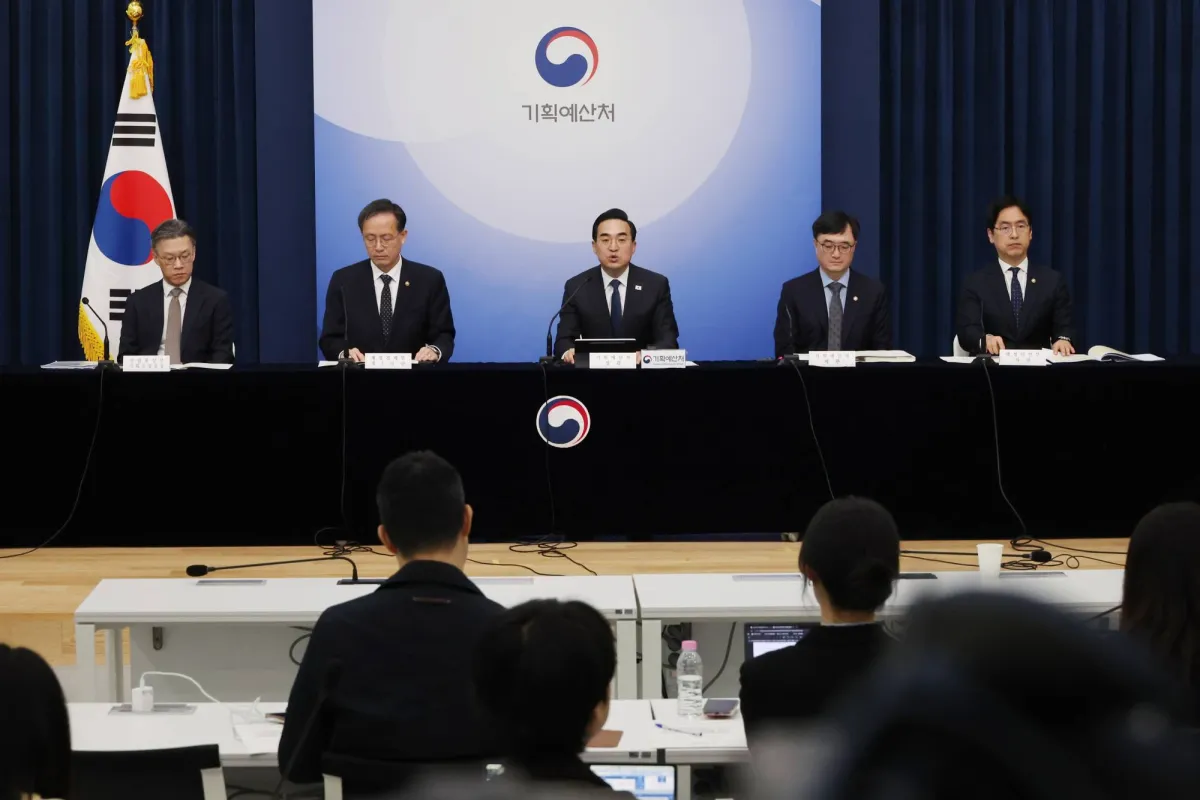
South Korea announced on Tuesday its proposal for a supplementary government budget of $17.3 billion to support consumers and businesses impacted by the repercussions of the war in the Middle East. This step comes at a time when oil prices are experiencing a sharp rise due to the U.S.-Israeli conflict over Iran, increasing growth and inflation risks for the fourth largest economy in Asia, which heavily relies on oil imports from the region.
This supplementary budget is the second within less than a year under President Lee Jae-myung, who pledged to adopt an expansionary fiscal policy to stimulate growth since taking office last June, according to Reuters.
Details of the Proposal
The total spending plan amounts to 26.2 trillion won ($17.3 billion), which includes 10.1 trillion won to address rising oil prices, 2.8 trillion won to support low-income individuals and youth, and 2.6 trillion won for businesses affected by the conflict in the Middle East, according to the Ministry of Budget. Among the notable measures, the government plans to allocate 5 trillion won to compensate oil refineries for losses incurred due to the nationwide price cap, a measure that was implemented this month for the first time in nearly 30 years.
The government will also allocate 4.8 trillion won to provide financial support through vouchers ranging from 100,000 won to 600,000 won per individual, depending on income level and region, while excluding the top 30 percent of income earners nationwide.
Background & Context
The Ministry of Budget clarified that it will utilize the surplus from tax revenues generated by the boom in semiconductor exports and the rising stock market to finance the supplementary budget, without issuing any treasury bonds. The plan also includes the repayment of treasury bonds worth 1 trillion won. This budget is expected to raise total government spending for 2026 to 752.1 trillion won, an increase of 11.8 percent from last year, thereby boosting economic growth by 0.2 percentage points.
Regarding the fiscal deficit, the ministry confirmed that it will decrease to 3.8 percent of GDP compared to the previously estimated 3.9 percent and 4.2 percent last year. Meanwhile, the debt-to-GDP ratio is estimated at around 50.6 percent compared to 51.6 percent previously and 49.1 percent projected for 2025.
Impact & Consequences
Weeks before the U.S. and Israeli attack on Iran on February 28, the Bank of Korea indicated that it would not adjust its monetary policy until at least August, while raising its growth forecast for 2026 to 2 percent compared to 1.8 percent previously, after the economy grew by 1 percent in 2025. Last year, the Lee administration prepared an additional budget of 31.8 trillion won just one month after taking office, which included its main program for distributing support vouchers aimed at stimulating domestic demand that had declined following the failed attempt by his predecessor Yoon Suk-yeol to impose martial law in December 2024.
This budget comes at a time when the South Korean economy faces significant challenges, as it heavily relies on oil imports from the Middle East, making it vulnerable to global price fluctuations. This measure is part of the government's efforts to mitigate the impact of rising prices on citizens and businesses amid volatile global economic conditions.
Regional Significance
This step by South Korea underscores the importance of government responses to economic challenges arising from regional crises. The rise in oil prices directly affects the economies of oil-importing countries, necessitating urgent measures to protect consumers and businesses. Moreover, these conditions could exacerbate economic crises in Arab countries that rely on oil imports, highlighting the need for greater coordination among nations to avoid potential economic crises.
In conclusion, this supplementary budget reflects the challenges faced by South Korea amid tense geopolitical conditions and emphasizes the urgent need to adopt flexible fiscal policies to address economic crises.