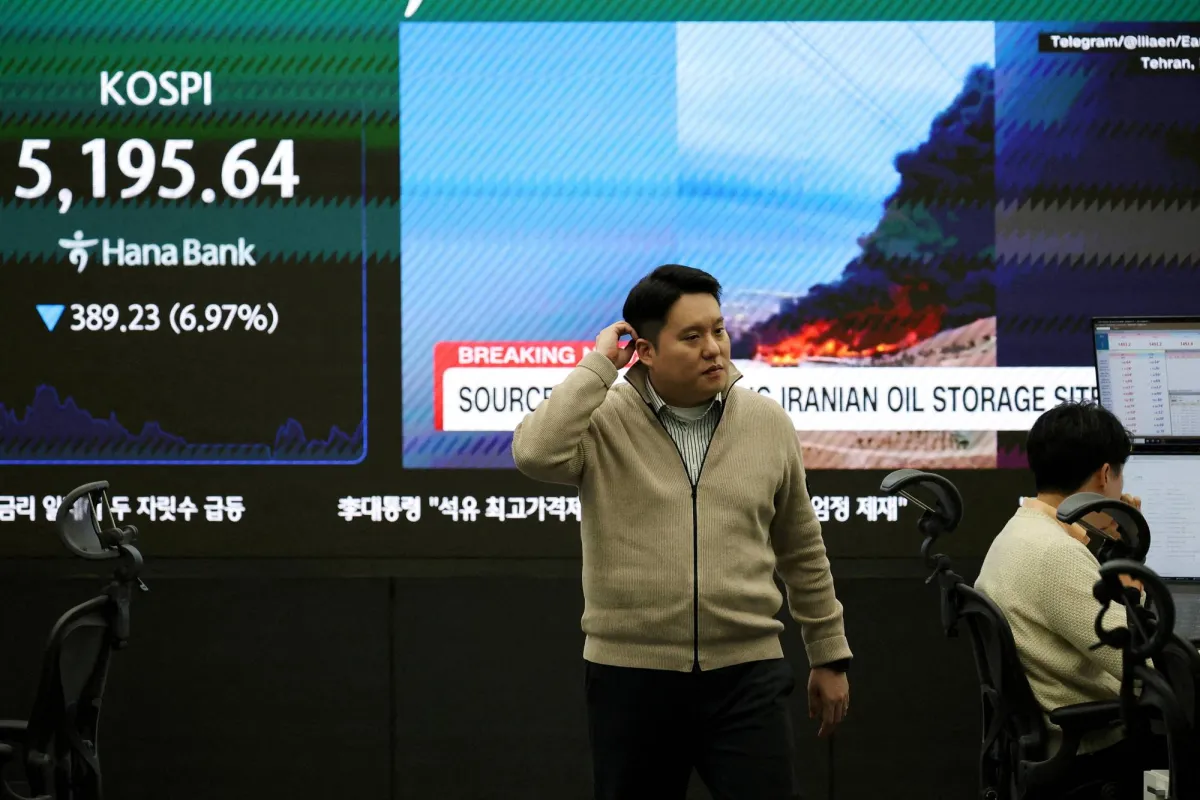
South Korea's financial markets saw a rebound on Friday, as the benchmark KOSPI index closed up by 143.25 points, equivalent to 2.74%, reaching 5377.30 points. Despite this recovery, the index recorded its second consecutive weekly loss, having declined by 1.1% last week, following a drop of 5.9% the week before.
These market fluctuations come amid uncertainty regarding the ongoing conflict with Iran, as dozens of countries seek to resume vital energy shipments through the Strait of Hormuz after U.S. President Donald Trump announced his intention to continue aggressive actions against Iran.
Market Volatility and Major Stocks
The Korean markets experienced sharp fluctuations, with trading restrictions imposed several times due to significant losses. However, the markets rebounded on Wednesday before recording another decline on Thursday. Regarding major companies listed on the index, shares of Samsung Electronics, a semiconductor manufacturer, rose by 4.37%, while shares of SK Hynix increased by 5.54%. Conversely, shares of LG Energy Solution fell by 1.48%.
Additionally, Hyundai Motor shares rose by 1.18%, while Kia Corp shares decreased by 0.27%. In the pharmaceutical sector, shares of Samsung Biologics dropped by 1.96%, leading to a sector decline of 1.37%.
Background & Context
These developments occur at a sensitive time, as the United States continues to impose tariffs on South Korean pharmaceutical products at a rate of 15% under the trade agreement between the two countries. Data showed that out of a total of 921 stocks traded, prices of 666 stocks rose, while prices of 226 stocks fell. Foreign net purchases of stocks reached 808.5 billion won, equivalent to 536.75 million USD.
Regarding the exchange rate, the won recorded 1506.8 won per dollar, an increase of 0.25% from the previous close. The yield on three-year Korean treasury bonds decreased by 2.9 basis points to 3.442%.
Impact & Consequences
The Korean markets are significantly affected by geopolitical disruptions, as the ongoing conflict in the region may exacerbate economic uncertainty. Additionally, rising oil prices due to these disruptions could negatively impact production costs in South Korea, potentially leading to increased inflation.
Moreover, continued pressures on the markets may prompt the central bank to take more stringent monetary actions, which could affect economic growth in the country. Data has shown that the consumer price inflation rate has declined, but pressures remain.
Regional Significance
The Middle East, particularly the Gulf states, is sensitive to developments in Iran. Many Arab countries rely on oil flows through the Strait of Hormuz, making them vulnerable to any potential disruptions. Rising oil prices could also impact the economies of these countries, especially amid ongoing tensions.
In conclusion, South Korean markets remain under significant pressure due to geopolitical conditions, necessitating close monitoring of developments by investors.