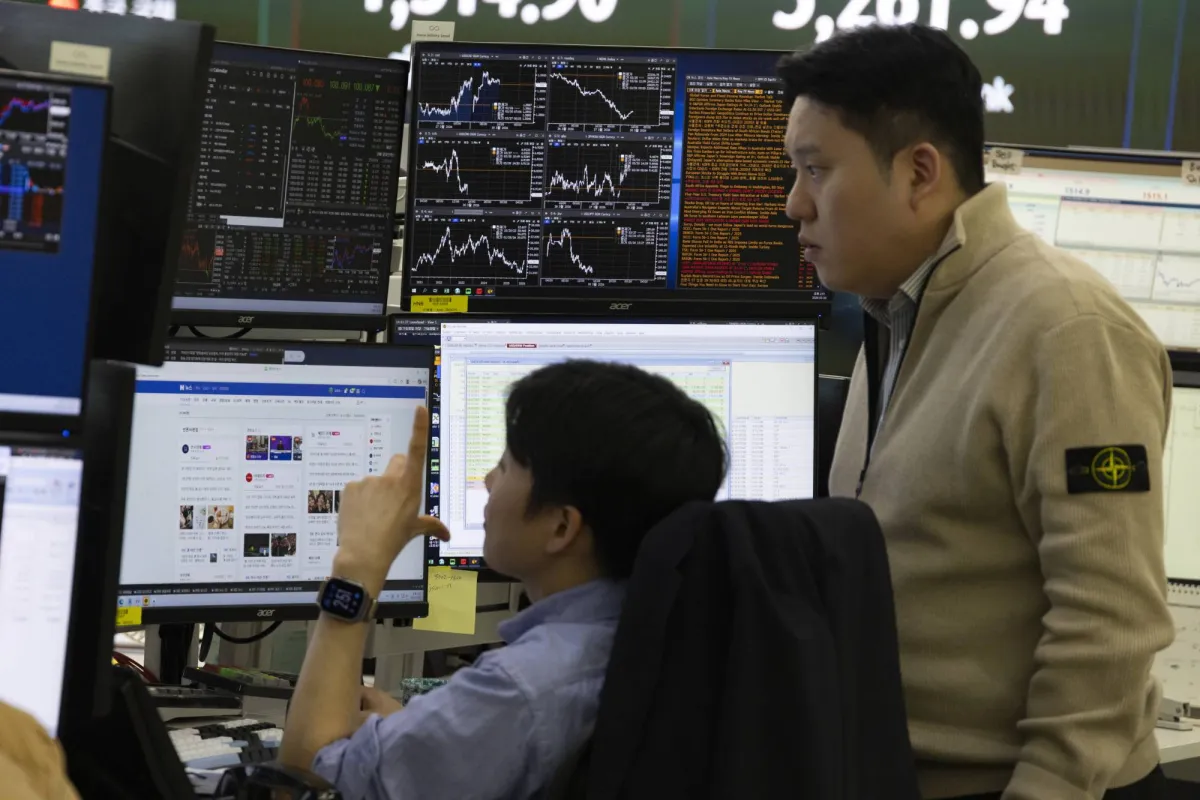
South Korean stocks fell by 3% on Monday, as the Kospi index closed down by 161.57 points, reaching 5,277.30 points. Meanwhile, the exchange rate of the won dropped by 0.5% to 1,518.7 won per dollar, marking its lowest level since March 2009.
These declines come amid escalating geopolitical tensions, as the Israeli army announced that Iran launched several waves of missiles at Israel, alongside a second attack from Yemen since the onset of the American-Israeli war. In this context, Pakistan announced its readiness to host talks to end the conflict with Iran, despite Tehran's accusations against Washington of planning a ground attack.
Market Analysis and Reactions
Commenting on the market, Lee Kyung-min, an analyst at Daishin Securities, stated: "Despite some positive indicators regarding negotiations, the market remains hesitant due to the uncertainty surrounding the situation in the Middle East." In this regard, the Financial Supervisory Service of South Korea announced that it will actively utilize market stabilization programs worth 100 trillion won ($65.84 billion) and will expand them if necessary.
A survey conducted by Reuters indicated that South Korea's exports in March likely increased at their strongest pace in nearly five years, driven by strong demand for semiconductor chips. However, the ongoing Iranian conflict is expected to pressure imports and increase inflation.
Background & Context
Most Asian markets declined in morning trading on Monday, amid rising fears of higher oil prices and the potential for further escalation in the confrontation between the United States and Iran. This decline followed sharp losses on Wall Street on Friday, which marked its fifth consecutive week of declines, the longest losing streak in nearly four years.
The Japanese Nikkei 225 index fell by 4.5%, while the Australian S&P/ASX 200 index dropped by 1.2%. The Hang Seng index in Hong Kong also fell by 1.7%, and the Shanghai Composite index decreased by 0.7%.
Impact & Consequences
Concerns are growing in Japan and other Asian countries about the potential disruption of supplies through the Strait of Hormuz, which is a vital artery for oil shipments. Investors are preparing for the possibility of the conflict continuing for a longer period, which could push global inflation to higher levels and undermine economic growth, especially in Asia.
Javier Lee, a senior equity analyst at Morningstar Research, stated: "Although we do not expect a prolonged conflict, markets are likely to experience sharp fluctuations in the near term." On Wall Street, the S&P 500 index fell by 1.7%, marking its worst weekly performance since the start of the war, while the Dow Jones Industrial Average lost 793 points.
Regional Significance
These developments directly affect the Arab region, where fears of rising oil prices are increasing and their impact on Arab economies that heavily rely on oil exports. Additionally, escalating tensions in the Middle East could exacerbate economic and social crises in Arab countries, necessitating urgent action from governments to stabilize markets.
In conclusion, it appears that the global economic situation faces significant challenges amid escalating geopolitical conflicts, prompting investors and analysts to closely monitor developments.