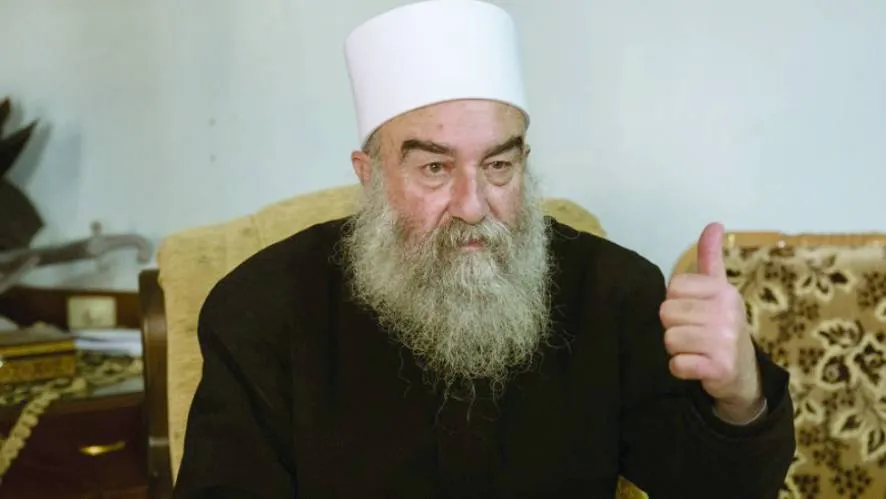
Sheikh Hikmat al-Hijri's statements regarding support for US and Israeli strikes against Iran have sparked widespread debate in Syrian circles. The head of security in Sweida, Suleiman Abdul Baqi, attacked al-Hijri, accusing him of inciting Syrians residing in Iraq, following the statement in which al-Hijri expressed his support for these strikes.
In the video statement delivered by al-Hijri, he reiterated his commitment to the principle of "self-determination," referring to his project of separating Sweida from Syria with support from Israel. Al-Hijri asserted, "We adhere to our inherent right to self-determination, according to international laws and charters that guarantee the rights of oppressed peoples, to obtain our full rights, relying on our own strength and the support of our strong allies, led by the State of Israel, to build a secure and stable future."
Details of the Event
In this context, al-Hijri expressed his support for what he described as the strategic direction of allies, praising the decisions made by the United States and Israel. He indicated that these movements represent an opportunity to end the chaos that the region has witnessed in recent years. He also held the Iranian regime responsible for destabilizing the Middle East, considering that its policies have negatively impacted the peoples of the region, including the Iranian people.
For his part, Abdul Baqi confirmed that officials in the White House and the US Department of Defense assured him during his recent visit to the United States that there was no communication with al-Hijri or support for him and his affiliated militias. He clarified that the US administration supports a unified Syria.
Context and Background
These statements come at a time when the situation in Sweida is experiencing increasing tensions, as al-Hijri seeks to strengthen his position as a local leader. The recent statement has sparked widespread controversy among Syrians, as activists have circulated images from 2017 showing al-Hijri alongside leaders of Iranian militias that were active in southern Syria. These individuals considered that al-Hijri is changing his positions according to sources of support and interests.
In this context, lawyer Mohammad Sabra noted that al-Hijri is nothing more than a local cleric, and that his talk about countries he described as "allies" is a form of "black comedy" indicating his disconnection from reality. He pointed out that al-Hijri leads a military militia that includes elements from remnants of the previous regime and wanted individuals, reflecting a state of chaos in Sweida.
Implications and Effects
Concerns are growing that the escalation of tensions between al-Hijri and the Syrian regime could exacerbate the situation in Sweida, where al-Hijri faces significant challenges in maintaining his authority. Sabra indicated that the Syrian authorities have erred in dealing with al-Hijri, as they have tried to appease him instead of taking decisive measures to resolve the crisis.
This situation may also open the door to military escalation in the region, complicating the political landscape in Syria. It appears that al-Hijri is seeking to exploit the current circumstances to strengthen his position, which could lead to a worsening of local conflicts.
Impact on the Arab Region
The developments in Sweida indicate that the situation in Syria remains fragile, and any escalation could affect stability across the entire region. Additionally, al-Hijri's pro-US and Israeli strike stance may provoke negative reactions from regional and international powers, further complicating relations between Syria and its neighbors.
In conclusion, the situation in Sweida poses a significant challenge to the Syrian regime, as al-Hijri seeks to strengthen his authority under complex circumstances. These developments could exacerbate crises in the region, necessitating close monitoring by the international community.