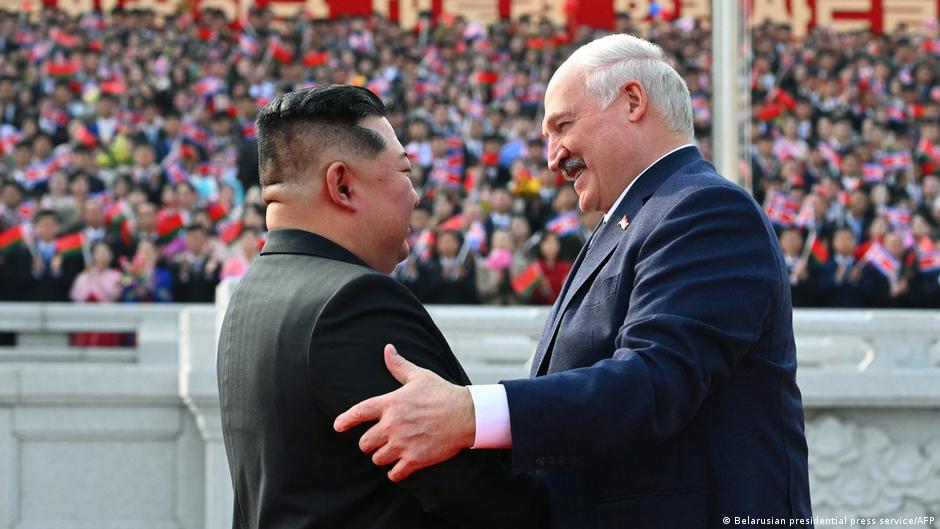
North Korean leader Kim Jong Un welcomed Belarusian President Alexander Lukashenko in the North Korean capital Pyongyang during a rare two-day visit, where a friendship and cooperation treaty was signed. This visit reflects Kim's efforts to strengthen a network of like-minded leaders as he seeks to expand his country's influence on the international stage.
During the visit, Kim expressed solidarity with the Belarusian leadership in its quest for social and political stability and economic development, emphasizing the importance of defending sovereign rights on the international stage. For his part, Lukashenko noted that the bilateral relations between the two countries, despite geographical distance, have entered a new phase of development.
Details of the Event
The discussions between the two leaders included plans to increase exchanges and cooperation in various fields, including diplomacy, information exchange, agriculture, education, and public health. Lukashenko presented Kim with an assault rifle as a gift, while Kim gifted him a decorated knight's sword.
These steps are part of strengthening relations between Russia and North Korea, as this meeting is considered part of the Moscow-Minsk-Pyongyang axis. Andrei Lankov, a professor of history and international relations, noted that this event enhances the status of these countries on the international stage and demonstrates that they are not isolated.
Background & Context
Historically, the relations between North Korea, Russia, and Belarus have been influenced by geopolitical tensions, especially amid rising American influence in the region. Under Kim's leadership, North Korea seeks to break free from its international isolation and strengthen its relations with countries opposing American hegemony.
In recent years, there has been a notable rapprochement between North Korea and Russia, as Kim seeks to leverage his relationship with Russian President Vladimir Putin to bolster his country's position. Additionally, Lukashenko's visit comes at a sensitive time as global tensions escalate, making these relations more significant.
Impact & Consequences
Analyses suggest that this visit may open the door for Belarus to benefit from North Korean military technology, including missile and drone technology. There are also concerns about the proliferation of this technology to other countries, which could increase tensions in the region.
Moreover, strengthening relations between these countries could lead to the formation of new alliances that may affect geopolitical balances in the region, especially in light of the challenges facing the United States and its allies.
Regional Significance
In the context of ongoing events, these developments may impact the Arab region by strengthening relations among countries opposing American influence. Any escalation in military tensions could negatively affect stability in the Middle East.
In conclusion, the relations between North Korea, Russia, and Belarus remain a significant focus, as these countries seek to enhance their alliances in the face of international pressures. These dynamics could affect many countries in the region, including Arab nations, which may find themselves amidst new geopolitical shifts.