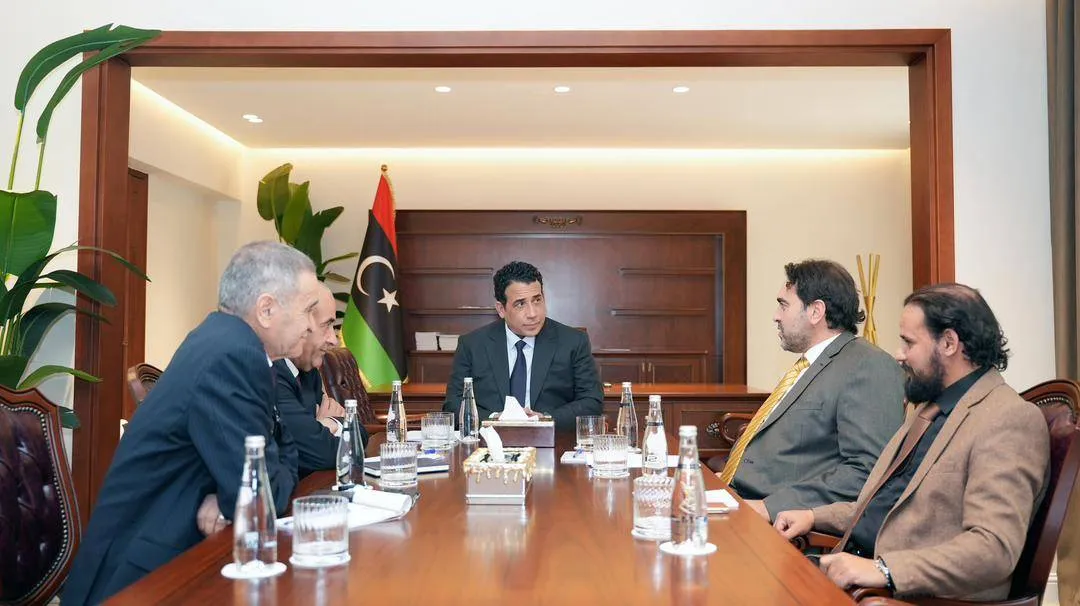
Mohamed Al-Menfi, the President of the Libyan Presidential Council, urged for intensified coordination between security and military agencies, stressing its importance in enhancing security and stability across all regions of the country. This statement came during a meeting with the military commander of the Western Mountain region, Osama Al-Juwaili, where Al-Menfi warned of a "deal" that could threaten the future of the Libyan state.
Al-Menfi emphasized the necessity of protecting borders and combating illegal immigration and organized crime, noting that the current phase represents a "critical crossroads" for the future of the political process in Libya. In a tweet on the platform "X", he indicated that Libya stands before "two contradictory options", reflecting the political and economic challenges facing the country.
Details of the Meeting
During the meeting held in Tripoli, Al-Menfi highlighted the importance of coordination among various security and military agencies, stressing the need for collective action to protect the country from internal and external threats. He also pointed out that Libya needs a "change option", calling for reliance on the will of the people to determine the course of the upcoming phase.
Al-Menfi's call comes at a time when debate is escalating over a U.S. proposal to unify the two rival governments in the country, with the High Council of State expressing its rejection of any political settlement that contradicts the provisions of the approved political agreement. The council confirmed that any representation in negotiations would not be recognized unless it was through an official mandate.
Background & Context
Libya has been experiencing a state of political division for years, with two governments competing for power: the "National Unity Government" in Tripoli and another government mandated by the parliament in the east. This division reflects the significant challenges the country faces in achieving political and economic stability.
In this context, Al-Menfi's deputy, Abdullah Al-Lafi, stated that the current phase requires more institutional discipline and integration of roles among different agencies. He emphasized that unifying efforts is a fundamental pillar for establishing security and enhancing stability in the country.
Impact & Consequences
Concerns are growing that any ill-considered political settlement could exacerbate the division in the country, potentially hindering efforts to achieve stability. Some politicians have warned that any agreement reached without a clear electoral path could return the country to square one, leading to renewed disputes among the active forces.
The United Nations mission also warned of the implications of the current judicial crisis on the unity of institutions, stressing the importance of supporting mediation efforts led by Libyan figures. The current situation appears to require a comprehensive national solution that ensures the participation of all concerned parties.
Regional Significance
Libya is a pivotal point in the North African region, and any political developments there affect regional stability. The stability of Libya could contribute to enhancing security in neighboring countries, while ongoing chaos may lead to negative repercussions on regional security.
In conclusion, hope remains pinned on the will of the Libyan people and their ability to overcome this difficult phase, achieving the political and economic stability that everyone aspires to.