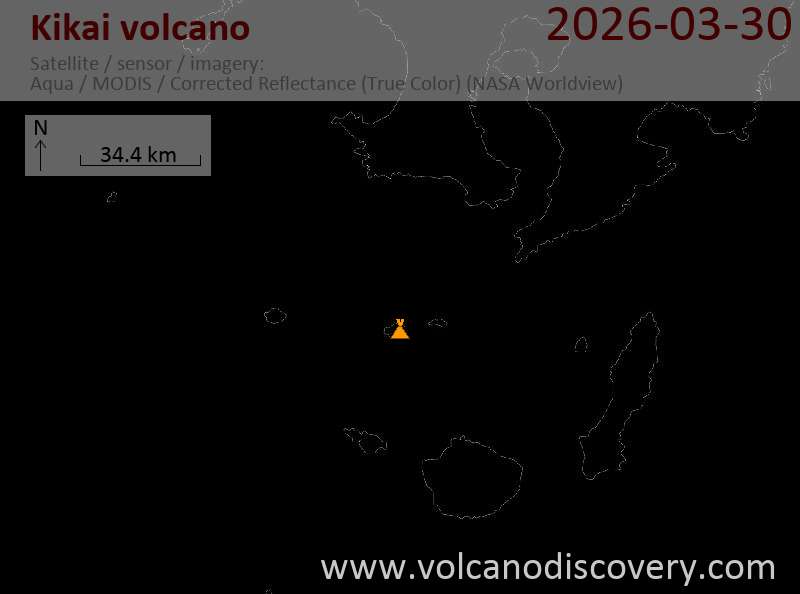
A recent study indicates that the magma reservoir beneath Kikai Caldera in Japan, which experienced the largest volcanic eruption 7,300 years ago, is being recharged with new magma, raising concerns about a potential eruption. These findings enhance scientific understanding of how so-called "supervolcanoes" operate and open new avenues in predicting their future behavior.
The supervolcano, which can unleash massive eruptions ejecting more than 1,000 cubic kilometers of volcanic material, is considered one of the most dangerous natural phenomena due to its wide-ranging climatic and environmental impacts. The study, published on March 27 in the journal "Communications Earth and Environment," focused on Kikai Caldera, most of which lies beneath the sea surface.
Details of the Event
The lead researcher of the study, Nobukazu Siyama, a geophysics professor at Kobe University in Japan, states that understanding how massive amounts of magma accumulate again is key to comprehending giant volcanic eruptions. When a supervolcano erupts, it can expel enormous quantities of molten rock, leading to the collapse of the volcano's summit and the formation of a large depression known as a "caldera."
These volcanoes are not ordinary; they are among the most perilous natural phenomena because they can release immense energy that affects global climate by ejecting vast amounts of ash and gases into the atmosphere. Among the most famous of these volcanoes are Yellowstone in the United States, Toba in Indonesia, and Kikai in Japan.
Background & Context
Although these volcanoes may remain dormant for thousands of years, they can erupt again when the right conditions arise. The problem lies in the fact that scientists know these volcanoes can become active again, but they do not fully understand how massive amounts of magma accumulate beneath them once more after an eruption.
Siyama emphasizes that "this question is extremely important because magma accumulation is the fundamental stage that precedes any major eruption; the better we understand this process, the more we can predict potential hazards." Kikai Volcano is notable for being mostly located beneath the sea surface, providing scientists with a unique opportunity to study it using extensive surveying techniques.
Impact & Consequences
The researchers employed techniques that involve sending artificial seismic waves into the earth, which are waves similar to those produced by earthquakes but generated in a controlled manner. The team measured how these waves traveled through the rocks using sensors distributed on the seabed, allowing them to create a picture of what lies beneath the earth's surface.
The results revealed a large area beneath the volcano containing magma, and its location appears to correspond with the area that experienced the massive eruption thousands of years ago. However, the surprise was that this magma is not merely remnants of the ancient eruption; evidence suggests it is new magma.
Regional Significance
These findings are significant not only for Japan but for the entire world, as giant volcanic eruptions can impact global climate and cause substantial environmental changes. In the Arab region, there may be indirect effects resulting from climate change, necessitating close monitoring of these phenomena.
In conclusion, this study highlights the importance of understanding natural phenomena and how they affect life on Earth. The scientific community must continue researching this field to ensure human safety and mitigate potential risks.