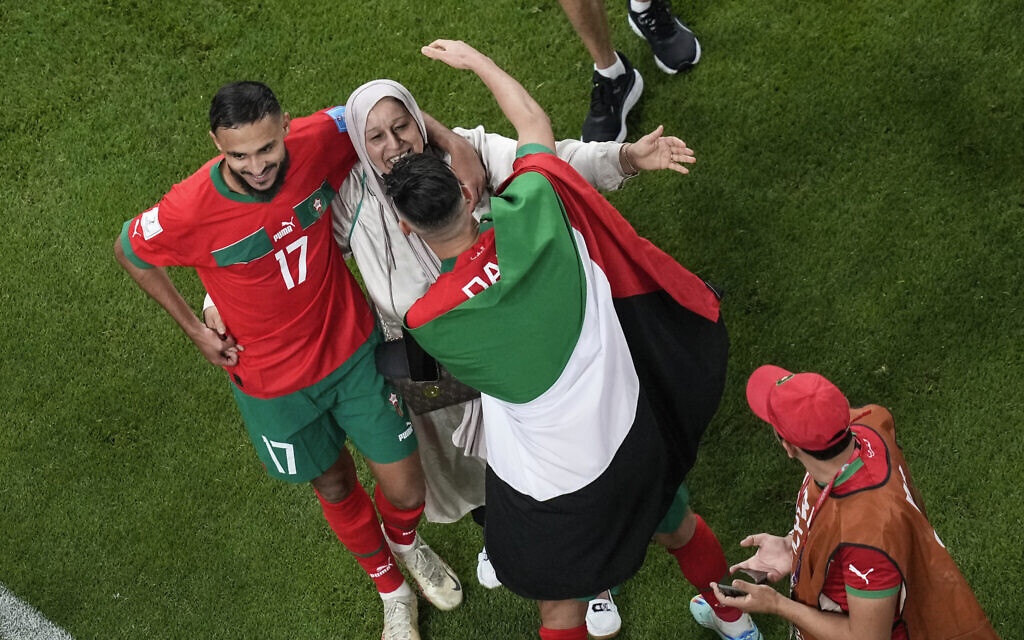
On Thursday evening, fans of the Moroccan Royal Army football club showed their solidarity with Palestinian prisoners in Israeli jails during a local league match held in the capital, Rabat. The match, which took place at the Prince Moulay Abdellah Stadium, saw the Royal Army team win three goals to two against Olympic Dcheira.
The Royal Army fans raised Palestinian flags and displayed banners expressing their condemnation of Israel's law permitting the execution of Palestinian prisoners. Among the phrases seen on the banners were "A nation in deep slumber," "The souls of the prisoners extinguish in horrific silence," and "Stop the execution of prisoners," reflecting strong sentiments of solidarity with the Palestinian cause.
Event Details
During the match, fans enthusiastically reacted to the events, chanting slogans in support of the Palestinian cause and denouncing the "Israeli crimes" against the Palestinian people. Anadolu Agency's correspondent captured these moments that reflect the public's awareness of the political and social issues affecting the region.
This show of solidarity comes at a sensitive time, as the Israeli Knesset had approved on March 30 a bill allowing the death penalty for Palestinian prisoners, which sparked widespread international outrage. The law permits the issuance of death sentences without a request from the public prosecutor and applies to military courts, escalating tensions in the region.
Background & Context
More than 9,500 Palestinians, including children and women, are currently held in Israeli prisons, amid human rights reports detailing violations including torture and medical neglect. This situation highlights the suffering of Palestinian prisoners, who endure harsh conditions within prisons, making public solidarity a matter of great importance.
Historically, the Palestinian issue has gone through many difficult phases, with prisoners always at the heart of the conflict. The enactment of the death penalty law represents a dangerous escalation in the occupation's policies and reflects a blatant disregard for basic human rights.
Impact & Consequences
The repercussions of this law extend beyond Palestine, raising widespread concern in the Arab and Islamic world. The imposition of the death penalty on Palestinian prisoners could exacerbate conditions in the region and heighten tensions between Palestinians and Israelis.
International reactions to this law have been negative, with many countries and human rights organizations considering it a flagrant violation of human rights. This could lead to increased international pressure on the Israeli government and heighten its isolation on the international stage.
Regional Significance
The Palestinian issue is a central concern in the Arab world, directly affecting relations between Arab countries and Israel. The solidarity demonstrated by the Royal Army fans reflects a growing awareness of the Palestinian cause and fosters a spirit of unity among Arab peoples.
This event reaffirms the importance of Arab support for the Palestinian cause and highlights the need for effective political actions by Arab governments to support Palestinian rights. Continued public movements may contribute to changing international stances towards the Palestinian issue.
In conclusion, solidarity with Palestinian prisoners remains essential and reflects the commitment of Arab peoples to their cause. Sporting events can serve as a powerful platform for expressing political and social stances, as demonstrated by the Moroccan Royal Army fans.