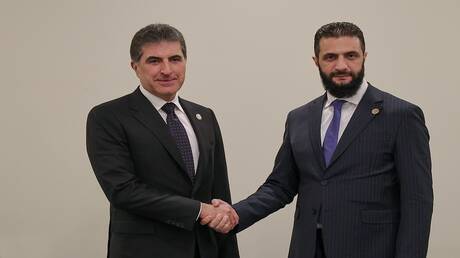
Syrian President Ahmad al-Shara condemned the attacks targeting the Iraqi Kurdistan Region during a phone call with the region's President Nechirvan Barzani. This call occurs at a sensitive time as the area faces increasing security tensions.
The attacks on the region have raised widespread concern among political and public circles, being viewed as a threat to security and stability in the area. During the conversation, al-Shara emphasized the need to enhance cooperation among countries to confront these security challenges.
Details of the Incident
In the statement issued by the Kurdistan Region Presidency, it was confirmed that al-Shara expressed his solidarity with the region in facing these attacks. The phone call addressed the security challenges facing the area and the importance of coordination between governments to tackle common risks.
These remarks come amid a rise in attacks on the region, which are sometimes attributed to armed groups seeking to destabilize the area. Barzani expressed his appreciation for al-Shara's stance, highlighting the importance of Arab support in confronting these challenges.
Background & Context
The Iraqi Kurdistan Region has enjoyed autonomy since 1991 and has experienced relative stability compared to the rest of Iraq. However, security tensions remain, particularly with the presence of armed groups in surrounding areas. Recent attacks are seen as an indicator of escalating tensions, necessitating urgent action from local authorities and neighboring countries.
Over the years, there have been numerous attempts to enhance security in the region, but challenges persist. The relationship between the Kurdistan Region and the central government in Baghdad plays a significant role in this context, requiring coordination and cooperation to address security threats.
Impact & Consequences
Attacks on the Kurdistan Region could lead to negative repercussions for regional security, potentially affecting investments and tourism in the area. Furthermore, the continuation of these attacks may increase tensions between the Iraqi government and the Kurdistan Region, which could adversely impact political stability in Iraq.
The security situation in the Kurdistan Region has a direct impact on neighboring countries, as the region serves as a vital transit point for various trade and transportation routes. Therefore, any escalation in violence could disrupt trade flows and heighten tensions among countries in the region.
Regional Significance
The events in the Kurdistan Region are part of the broader security landscape in the Middle East. Tensions in Iraq affect stability in neighboring countries, necessitating Arab and international attention. Cooperation among Arab countries to address shared security challenges has become an urgent necessity.
In light of these circumstances, Arab countries must bolster their efforts to support stability in Iraq and the Kurdistan Region by providing political and economic assistance. Additionally, enhancing dialogue among different parties could contribute to reducing tensions and achieving peace in the region.