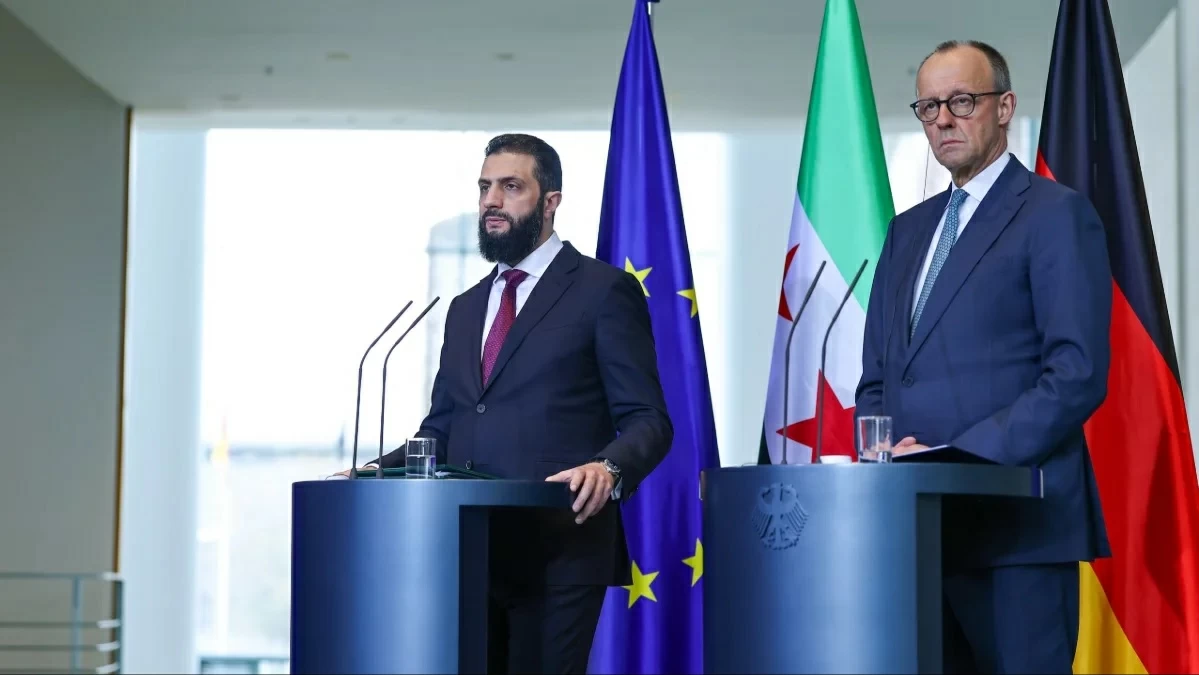
The Syrian President Ahmad al-Shara's disregard for an Israeli reporter, who attempted to ask him a question during a press conference in Berlin with German Chancellor Friedrich Merz, has sparked a wave of comments and inquiries on social media. The journalist asked, "Mr. President, I am from Israeli television, may I ask just one question regarding Israel?" However, al-Shara ignored him and left the room without responding, prompting the Israeli press to later criticize him.
This scene was not merely a fleeting reaction; many considered it a clear political stance. The incident ignited social media platforms in the Arab world, with a wave of comments interpreting al-Shara's disregard as a deliberate message reflecting his steadfast position towards Israel.
Details of the Incident
During the press conference held on Monday, the Israeli reporter Gil Har attempted to pose a question to al-Shara, but the latter chose silence and exited the room. This behavior puzzled many observers, as some viewed it as an expression of a consistent Syrian stance towards the Israeli media at a time when regional and international pressures on Damascus are increasing.
Moreover, the Hebrew media's focus on Syrian affairs at this stage appears unprecedented, with an official Israeli channel sending a correspondent to follow al-Shara's movements in Germany. This media attention could be interpreted as an attempt to reintroduce the Syrian file into the regional discussion, under the banners of peace or escalation.
Background & Context
Historically, Syrian-Israeli relations have been tense, with Israel not recognizing Syria as a sovereign state. In recent years, some Arab countries have attempted to normalize their relations with Israel, while Syria maintains its rejectionist stance. Al-Shara's dismissal of the Israeli reporter could be seen as part of a broader Syrian strategy aimed at preserving its firm position amid regional changes.
This stance comes at a sensitive time, as the region witnesses significant transformations, including attempts by some Arab countries to reassess their relations with Israel. In this context, al-Shara's actions serve as a clear message that Syria will not respond to normalization attempts.
Impact & Consequences
Al-Shara's disregard for the Israeli reporter may have repercussions on the level of regional relations. This behavior demonstrates that Syria remains committed to its rejection of normalization with Israel, which could affect attempts by some Arab countries to bridge views with Tel Aviv. Additionally, this stance may bolster the Syrian government's position domestically, showing that it remains strong in the face of external pressures.
On the other hand, this action could lead to increased tensions between Syria and Israel, as Israeli media might use this incident to portray Syria as an adversarial state. Consequently, this event could be viewed as part of a larger political game related to the regional conflict.
Regional Significance
Al-Shara's dismissal of the Israeli reporter could be seen as a call for other Arab countries to adopt similar stances towards Israel, especially amid increasing pressures for normalization. This event illustrates that there are still countries that adhere to their principles, despite rapid changes in the regional landscape.
Ultimately, this position reflects complex calculations in Syrian-Israeli relations and shows that Syria continues to play an important role in regional politics. It also indicates that there are larger issues that need addressing, and al-Shara's disregard for the Israeli reporter is merely a part of a broader political scene.