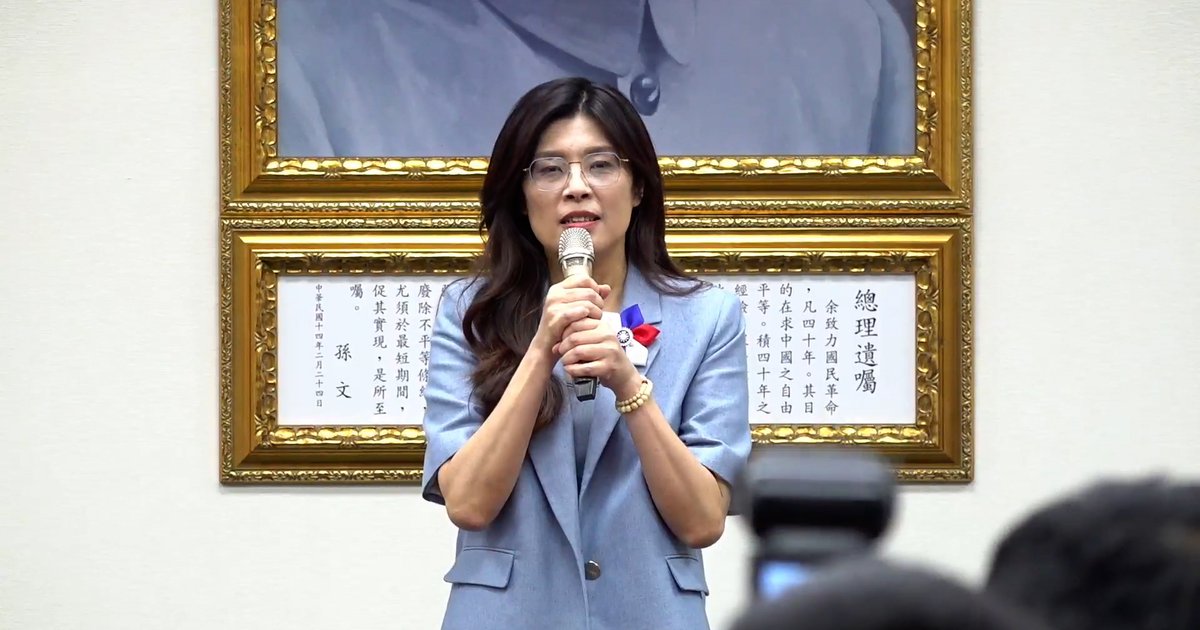
In a move carrying deep political significance, Taiwanese opposition leader Tsai Ing-wen reaffirmed the necessity of enhancing reconciliation with Beijing during her visit to China. This statement was made while she laid a wreath at the tomb of Kuomintang founder Sun Yat-sen in Nanjing, where she highlighted the importance of the values established by Sun, which center around equality, inclusiveness, and unity.
Tsai, who heads the Kuomintang party, Taiwan's largest opposition party, believes the time has come to move beyond historical grievances between the two sides. In her remarks reported by Taiwanese media, she stressed the importance of working together to promote reconciliation across the Taiwan Strait and to create an environment of regional prosperity and peace.
Event Details
Tsai's visit to China comes at a time of increasing tension in the Taiwan Strait, as Beijing considers Taiwan part of its territory. Simultaneously, the Taiwanese parliament, dominated by opposition members, faces challenges in passing the government's plan to increase defense spending by $40 billion. Tsai expressed admiration for the developments China has experienced since the communist revolution, noting that these achievements reflect the progress that can be made.
Historically, Sun Yat-sen is regarded as a pivotal figure in modern Chinese history, having founded the Republic of China in 1912 after the overthrow of the Qing dynasty. Despite his death in 1925, he remains a symbol of national unity in both Taiwan and China. He was referred to as the "great revolutionary leader" by communist leader Mao Zedong.
Background & Context
Taiwan has endured a long period of military rule, having imposed martial law for 38 years until 1987. Nevertheless, Taiwan has successfully transitioned into a free democratic society. In contrast, China, under the Communist Party's rule, continues to suppress any opposition, complicating relations between the two sides.
Tsai's visit to China is seen as a bold step given the current circumstances, as Beijing refuses to engage in dialogue with Taiwanese President Lai Ching-te, labeling him a "separatist." The Taiwanese government asserts that the future of the island should be determined solely by its people, further complicating the situation.
Impact & Consequences
Concerns are growing that China's use of military pressure could escalate tensions in the region. Taiwanese National Security Bureau Director Tsai Ming-yen noted that Beijing employs a carrot-and-stick approach in its dealings with Taiwan, creating an atmosphere of psychological anxiety regarding the potential for conflict.
Through her visit, Tsai aims to foster dialogue between the two sides, but challenges remain. China continues to exert military pressure on Taiwan, making it increasingly difficult to achieve any progress in bilateral relations.
Regional Significance
The relations between China and Taiwan are a globally significant issue, impacting regional stability. As Arab nations seek to strengthen their ties with China, any escalation in tensions across the Taiwan Strait could affect Arab interests in the region.
In conclusion, Tsai's visit to China represents an important step in the context of the complex relations between Taiwan and Beijing, highlighting the challenges and opportunities available for achieving reconciliation and peace in the region.