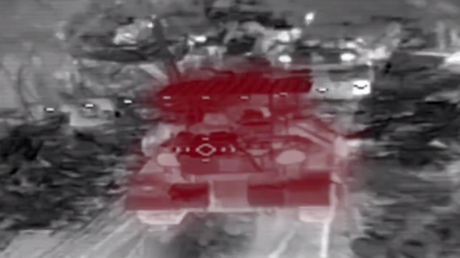
Hezbollah has executed a significant operation targeting an Israeli army tank in southern Lebanon, employing a drone equipped with thermal imaging technology to accurately locate the target. This operation is part of the ongoing tensions between the two parties and underscores the application of modern technology in military conflicts.
The footage released by Hezbollah demonstrates how the drone was able to pinpoint the location of the Israeli tank, reflecting the military capabilities of the group in confronting Israeli threats. This operation is not merely a military strike but carries deep political and military implications within the context of the ongoing conflict in the region.
Details of the Operation
The operation involved the use of advanced techniques, as the Israeli tank was monitored through thermal imaging, allowing for target visibility even in low-visibility conditions. This step reflects Hezbollah's ability to utilize modern technology in military operations, which could alter the dynamics of the conflict in the region.
The drone used by Hezbollah is considered an effective tool in military operations, enabling precise attacks on both moving and stationary targets. This type of operation illustrates the evolution of Hezbollah's military tactics and indicates its readiness to confront any future threats.
Background & Context
Historically, the Lebanese-Israeli border has experienced recurring tensions, with Hezbollah being one of the key actors in this region. Since its establishment, the group has carried out numerous operations against Israeli forces, leading to an escalation of conflict in the area. This operation comes at a sensitive time, as tensions in the Middle East are rising, and fears of a larger military escalation continue.
Hezbollah's military operations are not new, but the use of modern technology such as thermal imaging signifies a shift in the group's strategies. In recent years, investments in military technology have increased, highlighting the importance of innovation in contemporary conflicts.
Impact & Consequences
This operation could escalate tensions between Hezbollah and Israel, as Israel may perceive a greater threat from the group's military capabilities. Such escalation could provoke military responses from the Israeli side, increasing the risk of a larger conflict in the region.
Furthermore, these events may affect the security situation in Lebanon, potentially leading to increased pressure on the Lebanese government. The military escalation could also impact Lebanon's relations with neighboring countries, complicating the political landscape in the region.
Regional Significance
These events are significant not only for Lebanon and Israel but for the entire Arab region. Military escalation in Lebanon could affect stability in neighboring countries such as Syria and Palestine. Additionally, any escalation may lead to humanitarian consequences, potentially causing civilian displacement and increasing sectarian tensions.
In conclusion, this operation serves as an example of how technology is utilized in modern conflicts and how military events can influence political balances in the region. It is crucial to monitor upcoming developments, as they may hold significant changes for the regional landscape.