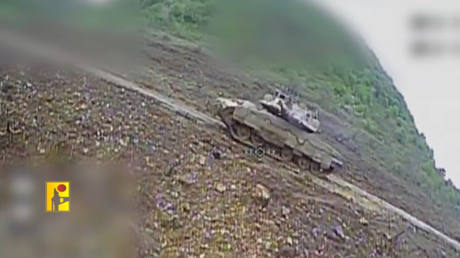
On Saturday evening, Hezbollah announced the targeting of two Israeli tanks in the Wadi al-Ayoun area of southern Lebanon. The operation was showcased through footage released by the party's media, indicating a rise in tensions between the two sides.
This operation comes at a sensitive time, as the region is experiencing increasing tensions due to political and military events. The footage published by the party shows the Israeli tanks coming under attack, raising questions about the military and political dimensions of this escalation.
Details of the Incident
According to Hezbollah's announcement, the operation was executed with high precision, targeting the Israeli tanks while they were present in the Wadi al-Ayoun area. This area is of strategic importance, located near the Lebanese-Israeli border, making it a constant point of tension between the two sides.
The released footage shows moments of the attack, reflecting the party's capability to conduct complex military operations under current circumstances. This operation has elicited varied reactions in political and military circles, with some considering it an escalatory step that could exacerbate the situation in the region.
Background & Context
Historically, the Wadi al-Ayoun area has witnessed numerous clashes between Hezbollah and the Israeli army, as it has been a theater for many military operations for a long time. This escalation occurs against the backdrop of ongoing tensions between the two sides, which have intensified in recent years due to regional disputes and political crises.
Additionally, the situation in Lebanon is suffering from economic and political crises, complicating the landscape further. Hezbollah, regarded as a political and military force in Lebanon, seeks to strengthen its position amid these crises, and this attack may be part of its strategy to assert its power in the face of internal and external challenges.
Impact & Consequences
This operation could lead to heightened tensions between Lebanon and Israel, threatening stability in the region. If Israel responds militarily, we may witness greater escalation that could drag the region into a wider conflict.
Potential repercussions include increased military operations along the border, which could affect civilians on both sides. Furthermore, these events may impact relations between Lebanon and neighboring countries, especially amid the political crises plaguing the region.
Regional Significance
These events are indicative of rising tensions in the Middle East, where many countries are grappling with political and economic crises. Such military operations could affect regional security, further complicating the situation in neighboring countries.
The military escalation between Hezbollah and Israel may also impact peace efforts in the region, intensifying divisions among various factions. Under these circumstances, the situation in Lebanon and the region at large remains under close observation, as conditions may change rapidly.
In conclusion, the targeting of Israeli tanks in Wadi al-Ayoun represents a new step in a series of military tensions between Hezbollah and Israel. As crises continue in Lebanon, the question remains about how these events will affect regional stability.