The Thai Minister of Transport, Vibhavadi Ratchakitprakarn, announced the implementation of targeted fuel support for the transport sector starting from April 1, as part of the government's efforts to tackle the challenges faced by transport operators due to rising fuel costs. This decision comes at a time when the sector is under increasing pressure due to soaring fuel prices, threatening to raise shipping costs.
Ratchakitprakarn, who also serves as the Deputy Prime Minister, confirmed that the Ministry of Transport has completed relief measures aimed at mitigating the impact of rising fuel prices on vulnerable groups in the transport industry and the traveling public. This program will run from the first to the thirtieth of April and will depend on actual usage, which will be verified through GPS tracking systems and operational monitoring systems maintained by the Land Transport Department.
Details of the Initiative
The assistance will be divided into two main groups. The first group includes unscheduled trucks, known as "yellow plate vehicles," totaling 287,175 units. Data from the Land Transport Department indicates that these vehicles collectively travel about 31 million kilometers daily, with an average fuel efficiency of four kilometers per liter, resulting in a daily fuel consumption of approximately 7.8 million liters.
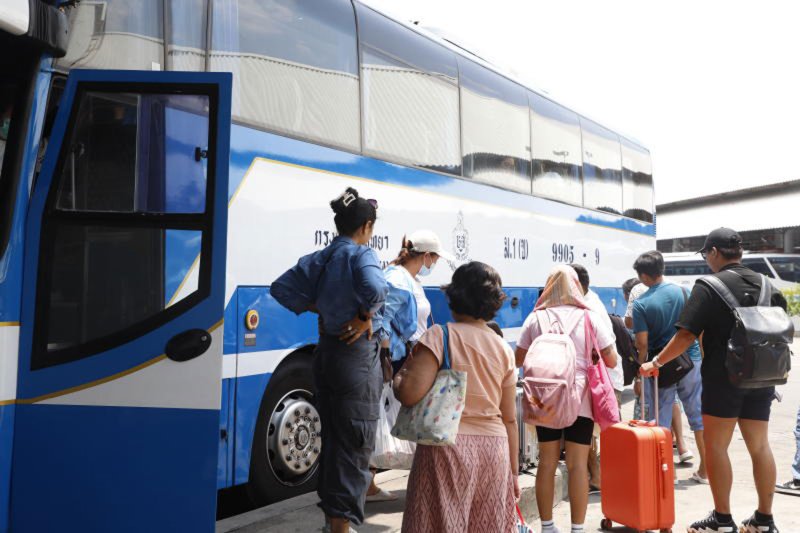
Under this program, the government will subsidize the cost of diesel by 6 baht per liter. The ministry aims to alleviate logistics costs for consumer goods and prevent this from impacting retail prices, which could increase the cost of living. The second group includes public transport operators and ride-hailing drivers. Interprovincial buses (categories 2 and 3), numbering 11,395 vehicles, will receive a subsidy of 4 baht per liter.
Background & Context
These steps come at a time when Thailand's transport sector faces significant challenges due to rising fuel prices, with diesel prices increasing from around 30 baht to 39 baht per liter. This rise has led to an increase in logistics costs by 3-5% with each baht increase in fuel price. The President of the Land Transport Federation of Thailand, Thungyu Khongkhan, noted that fuel now accounts for 45-50% of total transport costs.
Simultaneously, the federation announced plans to increase shipping fees nationwide starting from April 1, indicating that this increase will be phased across six to seven categories of vehicles, from four-wheeled trucks to large twenty-four-wheeled trucks. The initial increase is expected to reach 10%, potentially rising to 15% or even 20-30% depending on fuel price movements.
Impact & Consequences
These measures are deemed essential to stabilize prices and encourage the use of public transport, especially during the upcoming Songkran holiday. Ratchakitprakarn emphasized that payments will be performance-based rather than total payments. Operators without GPS systems will be required to install QR codes to track services and associated costs.
Experts assert that the increase in shipping fees will directly affect consumer prices and the broader economy, particularly impacting low-income households. Thungyu pointed out that this fee increase is not an option but a necessity to ensure business continuity.
Regional Significance
These steps in Thailand exemplify how governments are addressing the challenges of rising fuel prices and their impact on vital sectors. In the Arab region, many countries face similar challenges, with rising fuel prices affecting transport and logistics costs. Arab nations could benefit from studying this experience to develop similar support strategies to tackle economic crises.
In conclusion, targeted fuel support represents a positive step towards alleviating the burdens on Thailand's transport sector and reflects the global challenges many countries face amid rising energy prices.