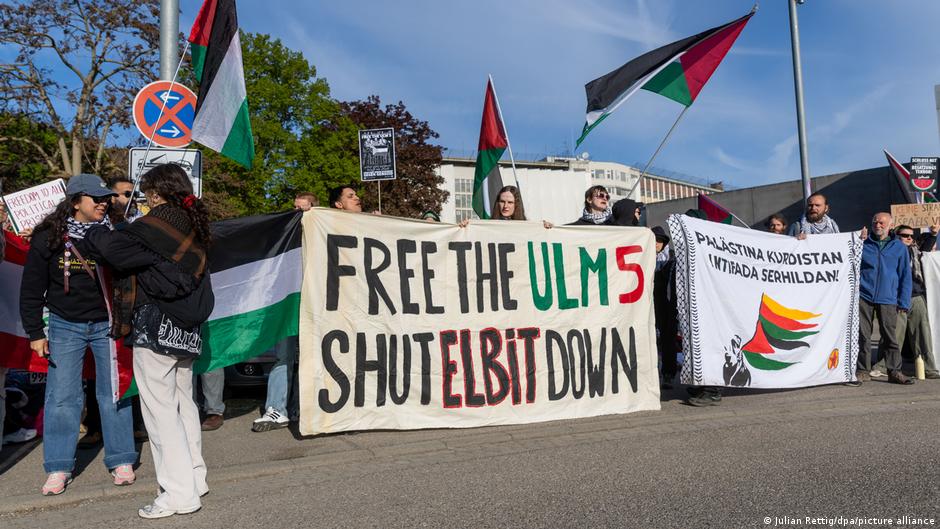
The trial of five activists in Germany has begun, charged with storming a branch of the Israeli arms company 'Elbit Systems' in Ulm in September 2025. The first session of the trial opened in a high-security court in Stuttgart on April 27, but was halted after just a few minutes due to lawyers' objections regarding their inability to communicate confidentially with their clients.
'Elbit Systems' is considered one of the largest arms manufacturers in Israel, with subsidiary factories in several countries. The company produces drones and communication equipment for various armies, including the German army. Germany is the second-largest arms supplier to Israel.
Details of the Incident
The defendants, who hold British, Irish, German, and Spanish nationalities, face charges related to trespassing, property destruction, membership in a criminal organization, and using symbols of terrorist organizations. They have been held in separate prisons since their arrest on September 8, 2025, and could face several years in prison if convicted.
Videos posted online show the activists storming the offices of 'Elbit Systems' in Ulm, where they vandalized several computers and other technical equipment, and spray-painted slogans on the walls, including the phrase 'child killers.' According to the defense, when security staff alerted the police, the activists waited at the site to be arrested.
Background & Context
The charges against the defendants are based on Article 129 of the German Penal Code, which prohibits the formation and membership in criminal organizations. This article has become controversial in recent years, as prosecutors have increasingly used it against other protest movements, such as the climate activist group 'Last Generation.' Amnesty International and others have argued that this article is misused by German prosecutors.
The Stuttgart prosecutor stated that the use of Article 129 was legitimate, as the group 'Palestine Action Germany,' to which the defendants allegedly belong, has been classified as a criminal organization by several courts prior to the trial. Defenders pointed out that they have yet to prove that 'Palestine Action Germany' exists as an official organization.
Impact & Consequences
The defense intends to emphasize that the 'Ulm 5,' as they are known, were trying to stop a genocide being carried out by Israel in Gaza, by 'aiding in self-defense.' German media, citing spokespeople from 'Elbit Systems,' reported that the Ulm facility was used to manufacture communication parts sold to the German army.
Mathis Breuer, the lawyer for defendant Leandra R., stated that they have evidence that the research conducted in Ulm is crucial for manufacturing drones. He confirmed that parts from Ulm are sent to 'Elbit' facilities in Israel, including technical components for tanks and drones.
Regional Significance
This trial comes at a sensitive time, as international criticism of Israel's conduct in Gaza is increasing. The International Court has begun investigating Israel's actions after South Africa presented a case before the United Nations' highest court in December 2023, accusing it of committing genocide. Many international human rights organizations have found that Israel's actions in the war constitute genocide, a claim that Israel denies.
In conclusion, this case highlights the growing tensions between human rights and security policies in Europe, shedding light on how countries deal with protest movements related to international issues.