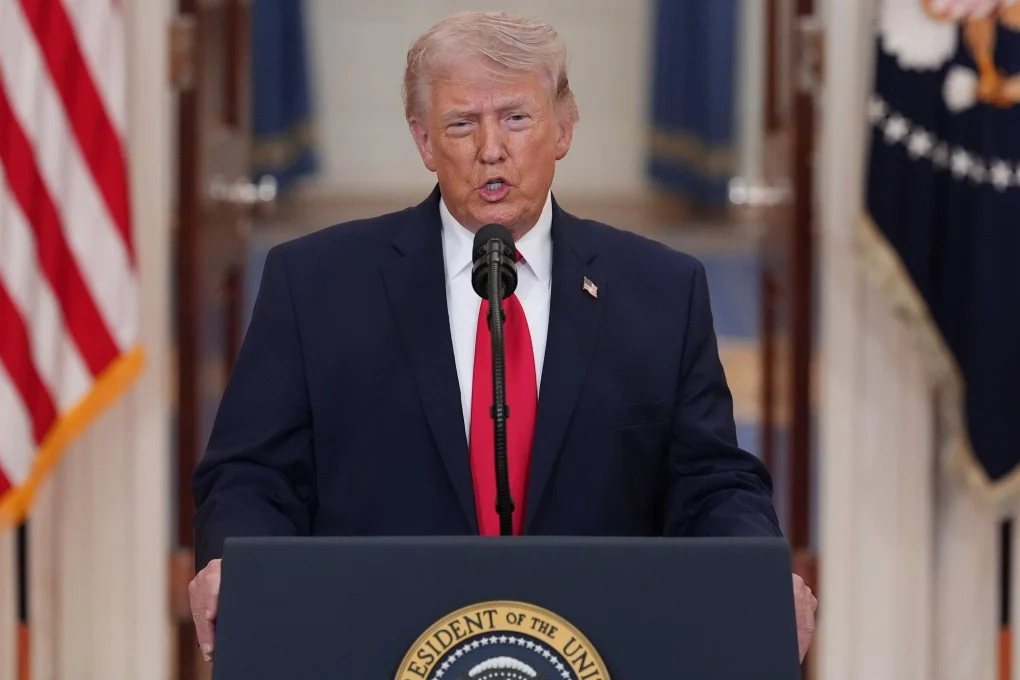
U.S. President Donald Trump announced on Wednesday that the war waged by the United States and Israel against Iran has achieved 'decisive victories,' suggesting that military objectives have been met and that the month-long military operations will conclude soon. This announcement comes at a time when tensions are escalating, raising concerns about its implications for regional and international security.
In his statements, Trump emphasized that the military operations have yielded tangible results, noting that the United States will leave the management of the blockade in the Strait of Hormuz to other countries, such as China, France, Japan, and South Korea, which rely on these maritime routes to secure their oil supplies.
Details of the Announcement
Trump's remarks come at a sensitive time, as the region has witnessed a notable escalation in tensions between Iran and the United States and its allies. The military operations have reportedly destroyed numerous Iranian military targets, according to U.S. officials. However, the military escalation has raised alarms in the international community, with many countries warning that the conflict could lead to a larger crisis in the region.
Trump, who adopts an 'America First' policy, appears to be seeking to reduce tensions with traditional allies, indicating that the management of the blockade in the Strait of Hormuz will be left to other nations. This shift in strategy may reflect Trump's desire to minimize U.S. military costs in a region considered extremely sensitive.
Background & Context
Historically, relations between the United States and Iran have been strained since the Islamic Revolution in 1979. Recent years have seen an escalation in conflict, particularly following the U.S. withdrawal from the Iranian nuclear deal in 2018. Since then, the United States has imposed strict economic sanctions on Iran, exacerbating the country's economic and political conditions.
The recent military operations come in the context of the U.S. and its allies' efforts to curb Iran's influence in the region, especially in Iraq, Syria, and Lebanon. These operations are viewed as part of a broader strategy aimed at countering Iranian activities deemed a threat to regional security.
Impact & Consequences
Trump's statements and military directives carry significant implications for regional and international security. While the U.S. administration may believe it has achieved victories, the military escalation could provoke reactions from Iran and its allies, potentially intensifying the conflict and worsening conditions in the region.
Additionally, leaving the management of the blockade in the Strait of Hormuz to other countries may raise questions about these nations' ability to handle security challenges in the area. The Strait of Hormuz is considered one of the world's most critical maritime corridors, through which approximately 20% of global oil supplies pass.
Regional Significance
For Arab countries, the rising tensions between the United States and Iran may directly impact security and stability in the region. Gulf states, which heavily rely on the stability of the Strait of Hormuz, may find themselves in a difficult position if conditions worsen. The conflict could also lead to increased sectarian tensions in the region, negatively affecting relations between Arab states and Iran.
In conclusion, the question remains whether these declared victories will lead to long-term stability in the region or trigger a new escalation of the conflict. Upcoming events will determine the future of U.S.-Iran relations and their impact on regional security.