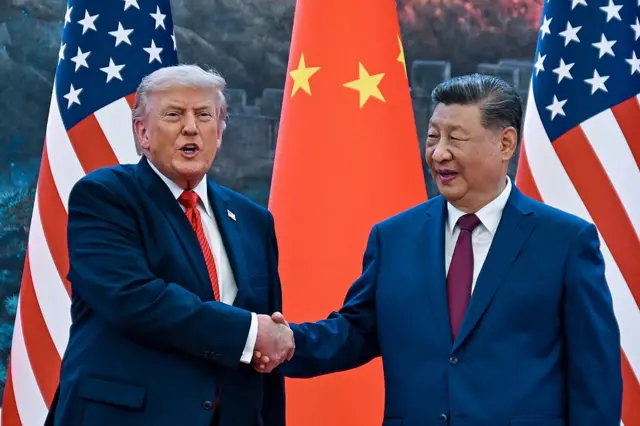
In a move reflecting the complexities of the geopolitical landscape, U.S. President Donald Trump and Chinese President Xi Jinping held high-level talks in the Chinese capital, Beijing, where vital issues related to the wars in Iran and Ukraine were discussed, along with ways to enhance economic cooperation between the two countries.
During the meeting, Trump noted that Xi Jinping offered the possibility of China assisting in opening the Strait of Hormuz, a strategic waterway through which approximately 20% of the world's oil passes. This offer comes at a sensitive time as tensions between the United States and Iran continue to escalate, raising concerns about its impact on global energy markets.
Details of the Event
The talks took place amid rising international tensions, with both the United States and China seeking to bolster their influence in the region. The discussions also covered developments in the war in Ukraine, where the two leaders exchanged views on how to address the current international crises.
Trump also confirmed that China pledged not to provide military support to Iran, which could help ease tensions in the region. This commitment comes at a critical time as the United States aims to reduce Iran's influence in the Middle East.
Background & Context
U.S.-China relations are among the most complex in the world, where economic interests intertwine with political and security issues. Since Trump took office, relations between the two countries have seen increasing tensions, particularly in the fields of trade and technology.
At the same time, the Middle East is undergoing significant transformations, with rising security and economic challenges. Iran is a key player in these dynamics, making any moves by major powers towards it have far-reaching implications.
Impact & Consequences
These talks could lead to changes in the strategies of major powers towards the Middle East. If China succeeds in opening the Strait of Hormuz, it could result in significant changes in oil prices and the balance of power in the region.
Moreover, China's commitment not to support Iran militarily may contribute to reducing tensions between the United States and Iran, potentially opening the door for a diplomatic resolution to the crisis.
Regional Significance
These developments are particularly significant for Arab countries, as the Gulf region plays a pivotal role in global energy markets. Any changes in the Strait of Hormuz could directly impact the economies of these nations.
Additionally, strengthening cooperation between the United States and China could influence regional policies, prompting Arab nations to reassess their strategies in light of these changes.
In conclusion, international relations remain in a state of continuous change, requiring Arab countries to closely monitor these developments, as any shifts could affect their security and stability.