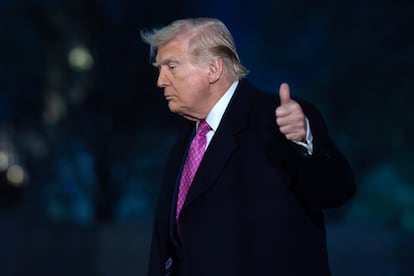
In a significant development, U.S. President Donald Trump has announced details of his vision for the war he has initiated against Iran in collaboration with Israel, presenting a mix of threats and contradictions during a series of statements and interviews. Since February 28 of this year, Trump has conducted more than fifty interviews and delivered numerous speeches, expressing his willingness to alter his positions at any moment.
During this period, Trump has utilized his platform on social media, Truth Social, to publish over forty posts regarding Iran, outlining his military objectives and clarifying his stance on Iranian threats. His rhetoric included references to previous military operations, such as the assassination of Iranian General Qasem Soleimani, reflecting the ongoing conflict between the United States and Iran.
Details of the Announcement
Trump clarified that the aim of the war is to protect the American people from Iranian threats, indicating that the Iranian regime consists of a group of hardliners. In his speeches, Trump emphasized that he would not allow Iran to possess nuclear weapons, expressing confidence in the U.S. military's ability to achieve the outlined military objectives.
He also touched upon the possibility of negotiations with Iran, but noted that no agreement would be reached without unconditional surrender from the Iranian side. He mentioned that he aims to influence the selection of new Iranian leadership, indicating that he does not want to end up with another leader like Ali Khamenei.
Background & Context
The roots of the conflict between the United States and Iran date back decades, with increasing tensions since the Iranian Revolution in 1979. These tensions escalated significantly after the U.S. withdrawal from the Iranian nuclear deal in 2018, leading to the imposition of severe economic sanctions on Iran.
In recent years, the region has witnessed an escalation in military operations, with the United States accusing Iran of supporting armed groups in Iraq, Syria, and Lebanon, further complicating the security landscape in the Middle East.
Impact & Consequences
Analysts predict that Trump's aggressive statements may escalate tensions in the region, potentially affecting oil prices and global markets. The repeated threats of military action could provoke responses from Iran, increasing the likelihood of open military conflict.
At the same time, these developments may impact U.S. relations with its allies in the region, as some question the extent to which the United States is prepared to cooperate with its allies in confronting Iranian threats.
Regional Significance
Arab countries, especially those close to Iran, such as Iraq and Saudi Arabia, find themselves in a sensitive position amid these tensions. Increased military tensions could lead to negative repercussions for security and stability in the region, threatening Arab interests.
Moreover, military escalation may affect oil prices, which could have repercussions on Arab economies that heavily rely on oil revenues. Under these circumstances, Arab countries must adopt strategic positions to safeguard their interests amid the rapidly changing regional landscape.