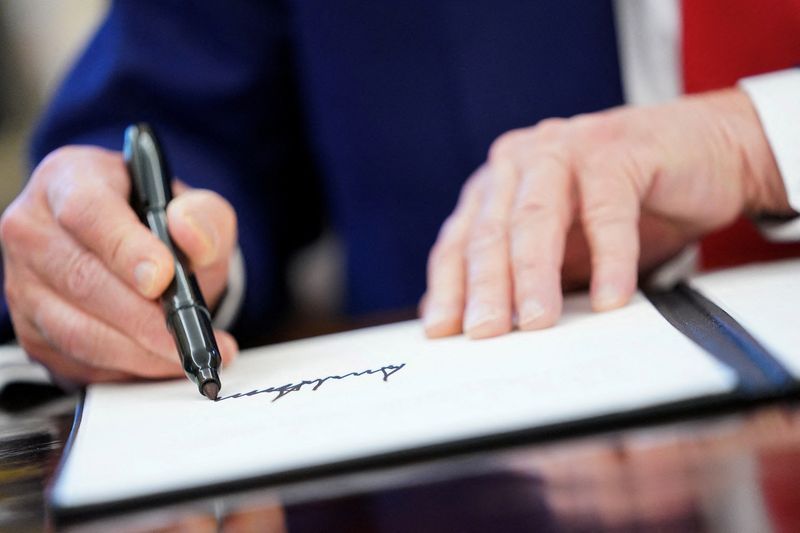
President Donald Trump's signature will appear on the $100 bill starting this June, marking the end of 165 years of Treasury Secretary signatures on U.S. currency. This historic change places Trump among a select group of global leaders whose signatures or images adorn currency, a rare occurrence among heads of major states.
This move comes at a time when the U.S. economy faces multiple challenges, as Trump seeks to bolster his image as a strong and influential leader. Trump's signature on the dollar is a symbolic step that reflects his authority and influence in U.S. monetary policy.
Event Details
The new $100 bill featuring Trump's signature is set to enter circulation in June, representing a significant shift in the history of American currency. Since 1861, the Treasury Secretary has been the only person authorized to sign banknotes, making this change a milestone in the history of the American financial system.
Trump's signature will appear at the bottom of the bill, making it one of the few currencies to bear the signature of a sitting president. Previously, this honor was reserved for a select few leaders, most of whom were from developing countries, highlighting the disparity between financial systems.
Context and Background
Historically, currencies reflect the power and prestige of a nation, often bearing the images of leaders or national symbols. In the United States, the Treasury Secretary has represented the government in signing banknotes, reflecting stability and reliability in the financial system.
Over the years, the signatures of leaders in many countries have been used as a means to promote national identity. In many developing nations, a president's signature on currency is seen as a sign of political strength, which is what Trump aims to achieve through this move.
Implications and Effects
Trump's signature on the dollar could have implications for U.S. monetary policy, potentially affecting public confidence in the currency. Amid current economic challenges, Trump may seek to use this move to strengthen his position in the upcoming elections.
Additionally, this change could increase interest in U.S. currencies in global markets, as the U.S. dollar is considered one of the most traded currencies in the world. This could enhance the United States' status as a major economic power.
Impact on the Arab Region
For the Arab region, Trump's signature on the dollar may have multiple effects. The U.S. dollar is the primary currency in many Arab countries, and any change in its value or public confidence could impact the economies of these nations.
Furthermore, this move may be viewed as part of Trump's strategy to enhance his influence in the region, especially amid the political and economic tensions experienced by some Arab countries.
In conclusion, Trump's signature on the $100 bill is a symbolic step that carries significant political and economic implications. This move may reflect Trump's aspirations to enhance his authority, but it also raises questions about its impact on the U.S. and global economies.