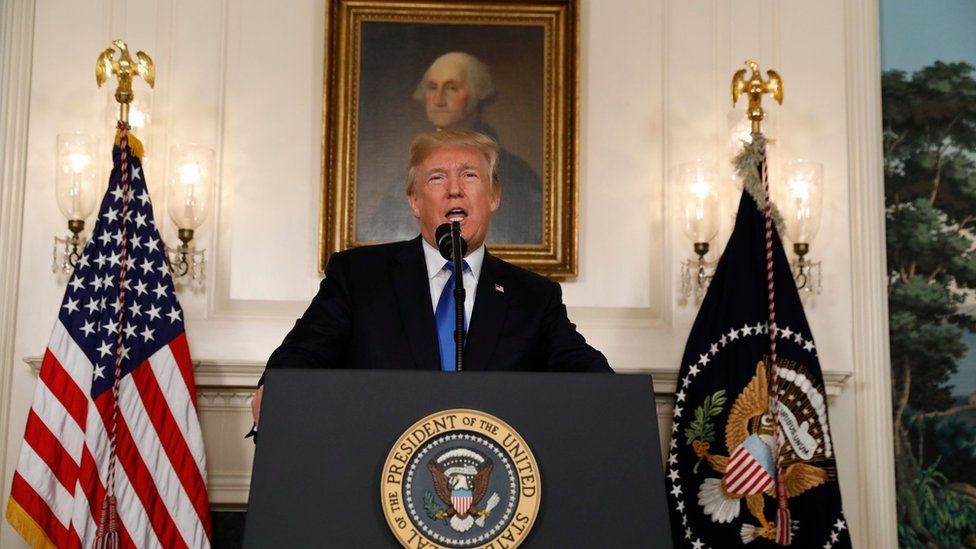
President Donald Trump's recent speech revealed ongoing ambiguity regarding the war on Iran, as he failed to provide a clear strategic vision for ending the conflict. The address came at a sensitive time, with increasing economic pressures on Americans, raising questions about the future of this war.
According to a report published by the New York Times and an article on The Hill, Trump's speech resembled messages from the previous administration, characterized by contradictions between promises of a swift resolution and a lack of a clear plan. The Trump administration attempted to balance reassuring domestic audiences and markets on one hand, while continuing military escalation on the other.
Key Insights from Trump's Speech
White House correspondents for the New York Times, Luke Broadwater and Tyler Pager, along with columnist Niall Stanage from The Hill, outlined five key conclusions from Trump's address. The writers agreed that the president did not present a clear path to end the war, as he sometimes called for negotiations, then threatened military escalation at other times.
Stanage also questioned Trump's claim that "the core objectives of the war are nearly complete," suggesting that this statement might merely be an attempt to reassure the American public without providing accurate details about the objectives that have been achieved.
In a related context, Trump stated, "We will hit them hard in the next two weeks or three weeks, and we will send them back to the Stone Age where they belong," further increasing the ambiguity surrounding the credibility of his claims that the war is nearing its end.
Context and Background
In an effort to absorb public anger, Trump sought to place the war in a historical context, comparing it to longer conflicts such as the World Wars and Vietnam, asserting that it remains relatively short. Despite implicitly acknowledging criticism of the war, he emphasized that it is an "investment in the future of generations to come."
The New York Times criticized Trump's "lack of empathy" for the economic burdens faced by Americans due to the war, as he attempted to alleviate their concerns over rising fuel prices by describing the increase as "temporary," blaming Iran for disrupting oil supplies.
Consequences and Implications
Both the newspaper and the website noted that Trump appeared to rule out a ground operation to seize enriched uranium in Iran, asserting that airstrikes thus far have caused significant damage to nuclear sites. However, the New York Times warned that his failure to decide on an attack could mean leaving nuclear materials within Iran's reach, raising questions about what the U.S. administration has actually achieved in terms of war objectives.
The article also pointed out that markets did not react positively to the speech, as Brent crude oil prices jumped from $100 to over $106 just one hour after the meeting ended, reflecting investors' concerns over the absence of a clear plan to end the war.
Impact on the Arab Region
Concerns are growing about the impact of the ongoing war on Iran on the stability of the Arab region, as military escalations could heighten tensions in the Arabian Gulf. Additionally, Trump's statements regarding the need for NATO allies to participate in "decapitation strikes" against the Iranian government may reflect deteriorating relations between the United States and its allies.
In conclusion, the question remains: Is the war truly nearing its end, or is it heading toward further escalation? The speech did not provide clear answers, but it reflects an internal struggle in interpreting the war's objectives and its impact on the American economy and international relations.