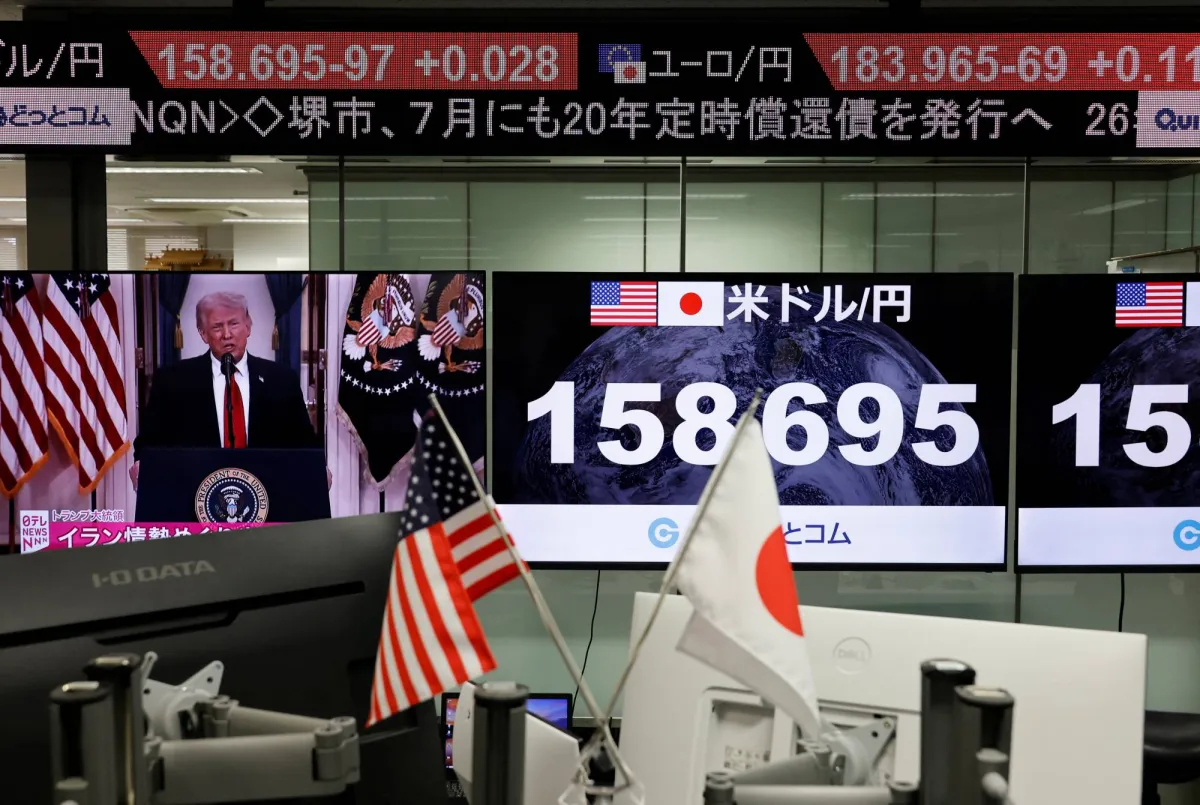
U.S. President Donald Trump's remarks about military escalation against Iran have caused confusion in global markets, leading to a surge in oil prices and a drop in stock indices. The absence of diplomatic solutions is heightening investor anxiety.
The global markets opened on Thursday with an aggressive speech from Trump, where he vowed unprecedented military escalation against Iran, resulting in a jump in oil prices exceeding 10%, breaking the $110 per barrel barrier. In contrast, stock indices from Wall Street to Tokyo plummeted, amid a complete lack of any diplomatic horizon to end the war or reopen the Strait of Hormuz.
Details of the Event
In his first national address since the outbreak of the conflict, Trump confirmed that the United States would intensify its military campaign in the coming weeks, stating sharply: "We will hit them with tremendous force... We will send them back to the Stone Age where they belong." Despite indicating that strategic objectives are "close to completion," Trump did not provide any timeline for halting operations, instead threatening to strike Iranian energy and oil infrastructure if Tehran does not comply with Washington's demands.
Trump's speech caused the price of U.S. crude to jump by $10.11 to reach $110.24 per barrel, while international Brent crude rose by 8% to $109.38. Additionally, standard futures contracts for diesel surged to exceed $200 per barrel for the first time since 2022.
Background & Context
Oil prices had been declining in recent days, while markets had risen after Trump hinted at the possibility of a resolution to the Middle East conflict within weeks. However, his speech from the White House added further ambiguity regarding the end of the war, negatively impacting investor sentiment.
In New York, futures contracts for the S&P 500 and Dow Jones fell by more than 1.4%, while the technology sector led the decline with the Nasdaq dropping by 2%. Industrial companies were not spared from the crisis, as shares of General Motors fell by 2% following a disappointing report on first-quarter sales.
Impact & Consequences
In Asia, the scene was even grimmer; the Korean KOSPI index plummeted by 4.5% and the Japanese Nikkei by 2.4%, driven by inflation rising to 2.2% in Korea due to fuel costs. In India, the central bank had to intervene with an extraordinary decision to halt trading in futures contracts to prevent the historic collapse of the rupee.
In Europe, the German DAX index recorded a severe loss of 2.4%, amid Italian fears of mass migration flows if the war continues. As uncertainty escalates, the dollar regained its status as the sole safe haven, leading to a 3.9% drop in gold prices, reaching $4627 per ounce.
Regional Significance
The International Monetary Fund and the World Bank warned that the war leaves "deep" economic impacts, emphasizing coordinated efforts to provide financial support to countries that are beginning to suffer from severe fuel shortages and disruptions in supply chains. In this context, U.S. economic data showed an expanding trade deficit, adding pressure to global markets.
As this tense situation unfolds, markets are bracing for the outcome of the "critical" three weeks defined by Trump, with growing concern over the implications of the conflict on the global economy.