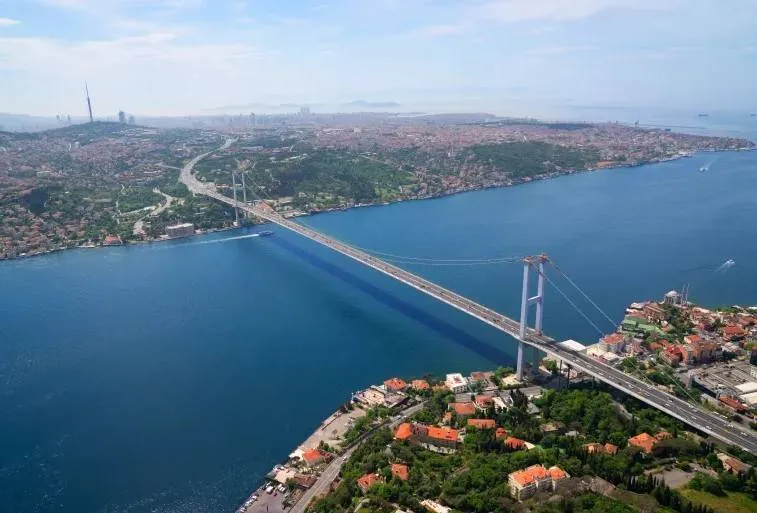
A new dispute has arisen between Turkey and Greece within the United Nations Security Council, sparked by the use of the term 'Turkish Straits' to refer to the straits connecting the Black Sea and the Mediterranean. Greece has objected to this designation, claiming it conflicts with the Montreux Convention that regulates navigation in these waterways.
In a letter sent by Turkey's Permanent Representative to the UN, Ahmet Yildiz, to the Permanent Representative of China and the UN Secretary-General, he argued that Greece's objection serves internal political interests, describing it as 'regrettable.' The letter emphasized that Turkey strongly rejects the Greek claims, noting that attempts to politicize the geographical term do not contribute to constructive dialogue or regional stability.
Details of the Event
Reports indicate that Yildiz confirmed that the term 'Turkish Straits' is a well-established geographical expression used to refer to the Bosphorus and Dardanelles straits, which are under Turkey's sovereignty. He explained that this term has traditionally been used in numerous international documents, including resolutions from the International Maritime Organization and NATO.
He also pointed out that the Montreux Convention regulates passage through these straits, but it does not aim to standardize geographical names. Yildiz asserted that Greece's attempts to impose alternative terms can only be interpreted as 'historical aspirations' that will not affect the existing legal or political status.
Background & Context
Historically, relations between Turkey and Greece have been marked by ongoing tensions, particularly regarding maritime boundaries and the issue of the Aegean Islands. Both countries have expressed a desire to ease tensions and build trust, despite the unresolved contentious issues. The Bosphorus and Dardanelles straits are strategic waterways connecting the Black Sea and the Mediterranean, with the Bosphorus being approximately 30 km long, while the Dardanelles is known for its strategic location in Çanakkale Province.
It is noteworthy that disputes over these straits are not new, as they have been central to international conflicts throughout history, reflecting the geopolitical significance of these waterways.
Impact & Consequences
These disputes could exacerbate tensions between the two countries, impacting regional stability. Additionally, the use of the term 'Turkish Straits' may provoke mixed reactions from other countries, complicating international relations in the region.
Furthermore, any escalation in the disputes could affect commercial navigation through these straits, which are considered among the most important waterways in the world, potentially negatively impacting the global economy.
Regional Significance
These disputes hold particular importance for Arab countries, as the stability of the Mediterranean region directly affects security and energy in the area. Any escalation in tensions between Turkey and Greece could lead to undesirable repercussions for regional security.
In conclusion, dialogue and understanding between Turkey and Greece remain an urgent necessity to avoid escalating disputes and ensure regional stability. Respecting sovereignty and using geographical terms accurately can contribute to enhancing relations between the two countries and increase opportunities for regional cooperation.