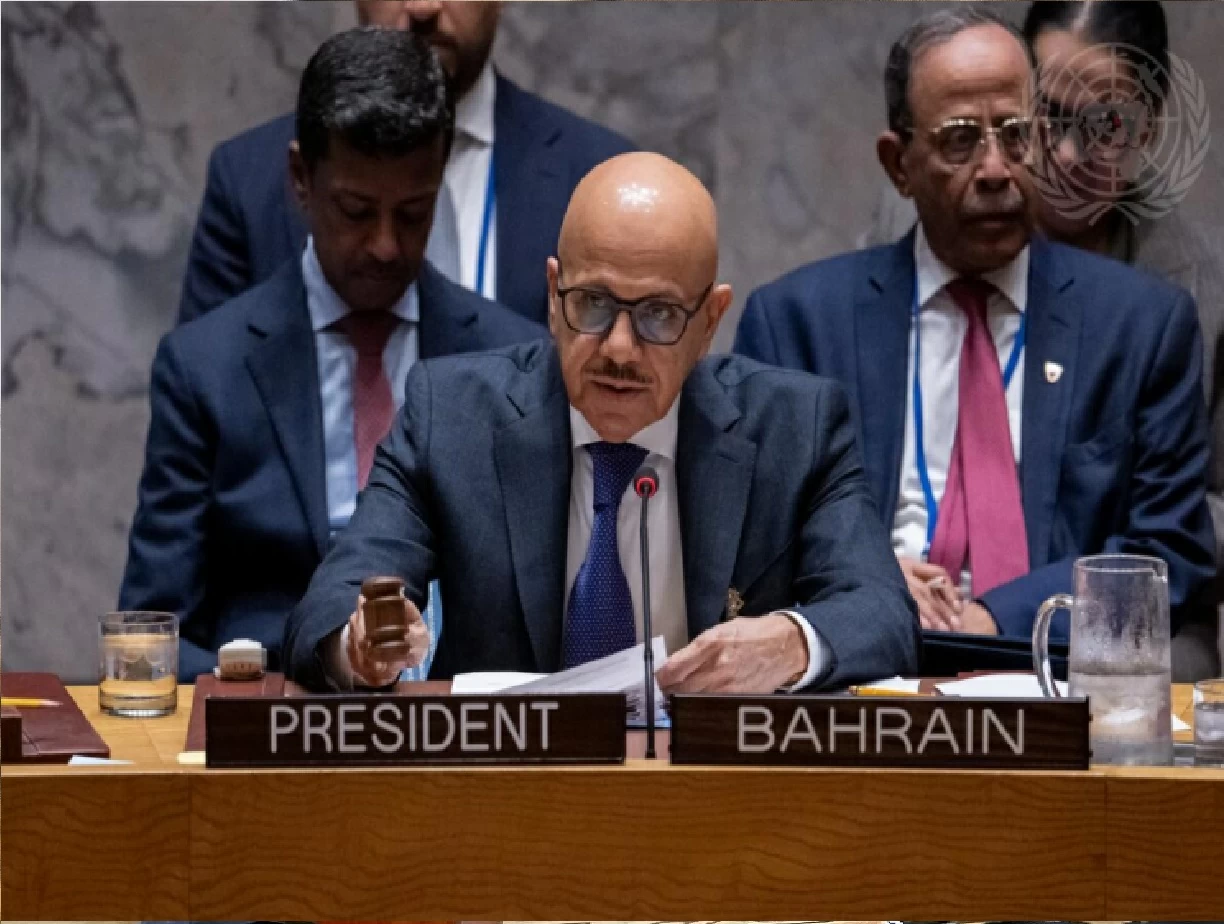
The UN Security Council renewed its primary responsibility for maintaining international peace and security today (Saturday), referencing all its previous resolutions and presidential statements that highlight the importance of establishing effective partnerships between the UN and regional and sub-regional organizations, in accordance with Chapter VIII of the UN Charter.
Under the presidency of Bahrain's Foreign Minister Dr. Abdullatif bin Rashid Al Zayani, the Security Council expressed its appreciation for the briefings provided by the Assistant Secretary-General for Middle East, Europe, the Americas, and Asia-Pacific Affairs, Khaled Khairy, and the Secretary-General of the Gulf Cooperation Council (GCC), Jasem Al Budaiwi. These briefings underscored the significant role that regional organizations play in addressing issues of international peace and security.
Event Details
The Security Council affirmed the status and expertise of the Gulf Cooperation Council in relation to the concept of sustainable regional peace and security. It also acknowledged the GCC's contributions to achieving regional and international stability through mediation, preventive diplomacy, technical and financial support, and engagement in humanitarian work, supporting preventive initiatives undertaken through the peacebuilding continuum.
In concluding its high-level discussions on cooperation between the GCC and the UN under the agenda item (Cooperation between the UN and regional and sub-regional organizations in maintaining international peace and security), the Security Council welcomed consultations between the two secretariats of the UN and the GCC.
Background & Context
The Security Council emphasized the importance of enhancing institutional cooperation between the UN and the GCC through regular dialogue, coordination mechanisms, and information exchange in areas such as conflict prevention, mediation, peacebuilding, counter-terrorism, and humanitarian response. It also referred to its previous relevant resolutions that consider the significance of the Gulf region concerning international peace and security and its vital role in global economic stability.
The Council highlighted the significant contributions of GCC member states to the UN's activities in peacekeeping and humanitarian work. It encouraged the Secretary-General of the GCC to hold regular briefing sessions aimed at strengthening cooperation and strategic coordination more closely with the UN, particularly regarding addressing emerging threats and challenges to peace and security in the region.
Impact & Consequences
The Security Council also encourages joint efforts between the UN and the GCC to elevate the full and meaningful participation of women and youth in promoting peace and security in accordance with resolutions 1325 (2000) and 2250 (2015). The Council reaffirmed its support for cooperation between the UN and the GCC to address common challenges, including maritime security, counter-terrorism, and responses to food and water security.
The Council reaffirmed its strong commitment to the sovereignty of all member states of the GCC, their independence, unity, and territorial integrity, in line with the principles of the UN Charter and international law.
Regional Significance
The UN Security Council requested the Secretary-General to include, in his upcoming report to the Security Council and the General Assembly on cooperation between the UN and regional organizations and other entities, recommendations on enhancing institutional relations and cooperation between the UN and the GCC.
Additionally, Bahrain's Foreign Minister Abdullatif bin Rashid Al Zayani met with the permanent representatives of the GCC states and Jordan accredited to the UN at the Permanent Mission of Bahrain in New York, in the presence of UAE Minister of State for Foreign Affairs, Lena Nusseibeh.
Al Zayani emphasized that "the political responsibility of the GCC states and Jordan at this crucial historical juncture necessitates continuing diplomatic efforts, coordinating with brotherly and friendly countries, and international partners to resolve the international crisis caused by Iran's closure of the Strait of Hormuz," praising the level of ongoing coordination among the representatives and the continuous communication with the representatives of the Security Council member states to reach a final formulation of a draft resolution that aligns with the objectives of the Council states and Jordan to expedite the reopening of the strait to international navigation and spare the world the repercussions of its closure on the global economy and energy security.