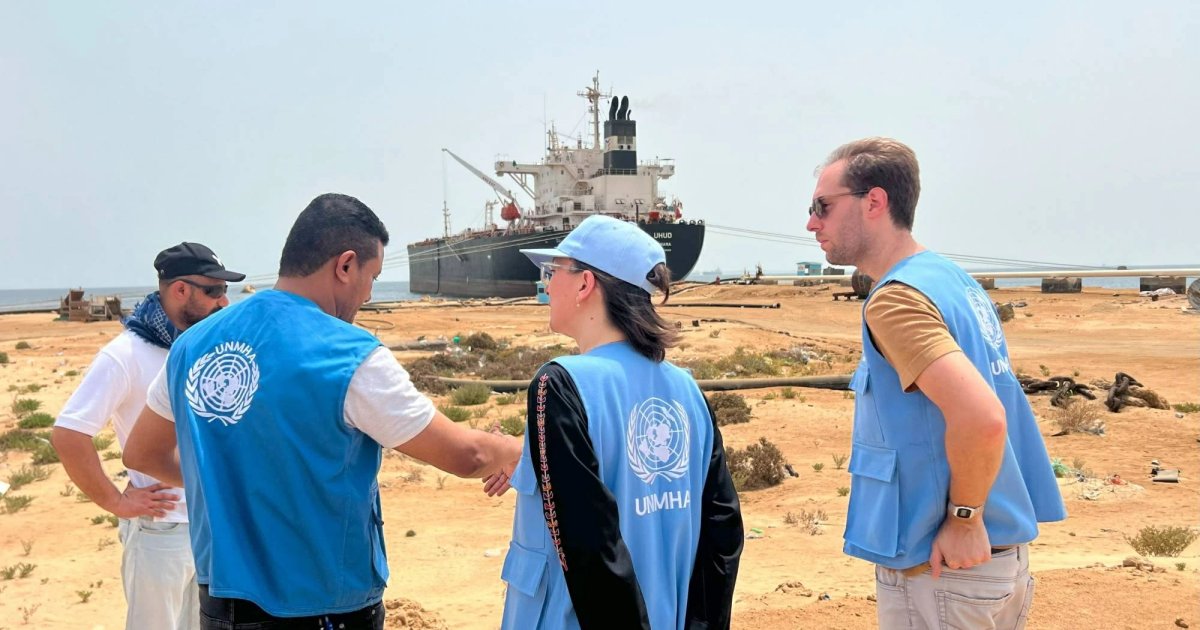
The United Nations mission in Hodeidah announced today, Tuesday, the transfer of its remaining tasks to the office of the Special Envoy to Yemen, Hans Grundberg, as part of ending its operations in accordance with Security Council Resolution 2813.
In an official statement published on its website, the United Nations Mission to Support the Hodeidah Agreement (UNMHA) confirmed that a joint team from the mission and the Special Envoy's office, led by Mari Yamashita, the acting head of the mission, conducted online consultations with the Yemeni government delegation in the Redeployment Coordination Committee on March 26, 2026. The discussions focused on the joint achievements of the committee, as well as the remaining tasks and necessary arrangements for the transition to the office of the Special Envoy of the Secretary-General.
Details of the Event
The mission and the envoy's office reaffirmed the United Nations' commitment to continue supporting the implementation of the Hodeidah Agreement, emphasizing the importance of ongoing communication and cooperation to support stability in Hodeidah and Yemen as a whole. It clarified that following consultations held with the concerned parties over the past months, the United Nations Mission to Support the Hodeidah Agreement will complete the transfer of its remaining tasks to the Special Envoy's office, which means ending its operations on March 31, in accordance with Security Council Resolution 2813.
It is noteworthy that the United Nations Mission to Support the Hodeidah Agreement was established under Security Council Resolution 2452 in 2019, based on the outcomes of the Stockholm Agreement reached in December 2018 between the Yemeni government and the Houthi group. Its tasks included overseeing the ceasefire, the withdrawal of all military forces from the three Hodeidah ports and the city, and handing them over to local security forces. However, these objectives have not been fully realized on the ground, as the mission has only issued a monthly bulletin regarding mine victims.
Background & Context
The United Nations Mission to Support the Hodeidah Agreement was established in the context of the ongoing conflict in Yemen, which began in 2014, leading to an unprecedented humanitarian crisis. The mission's goal was to achieve peace and stability in the region, but field and political challenges have hindered the achievement of the desired objectives. Despite the efforts made, the humanitarian situation in Hodeidah and other Yemeni areas continues to suffer from the repercussions of the conflict.
In recent years, Hodeidah has witnessed an escalation in hostilities, exacerbating the humanitarian situation. The United Nations, through its mission, has attempted to make progress in the peace process, but the realities on the ground have impeded these efforts.
Impact & Consequences
The termination of the United Nations Mission to Support the Hodeidah Agreement may have significant implications for the situation in the region. With the transfer of tasks to the Special Envoy's office, it is expected that pressures on the concerned parties to make progress in the peace process will increase. This transition may also raise questions about the United Nations' ability to continue supporting peace efforts under the current circumstances.
This change is likely to lead to a reassessment of the strategies employed by the concerned parties, as they must deal with the new reality imposed by the termination of the United Nations mission. This may also affect the humanitarian situation in Hodeidah, where many residents rely on international aid.
Regional Significance
The situation in Yemen is part of a broader landscape in the Arab region, where political and economic crises intersect in many countries. The ongoing conflict in Yemen and the failure to achieve peace could negatively impact stability in neighboring countries, necessitating greater international attention to resolve this crisis.
Amid regional tensions, hope remains pinned on the international community's efforts to achieve peace in Yemen, as the stability of this country could contribute to enhancing security and stability throughout the region.
In conclusion, the future of Yemen remains uncertain, as the current conditions require further efforts and cooperation from all concerned parties to achieve the desired peace.