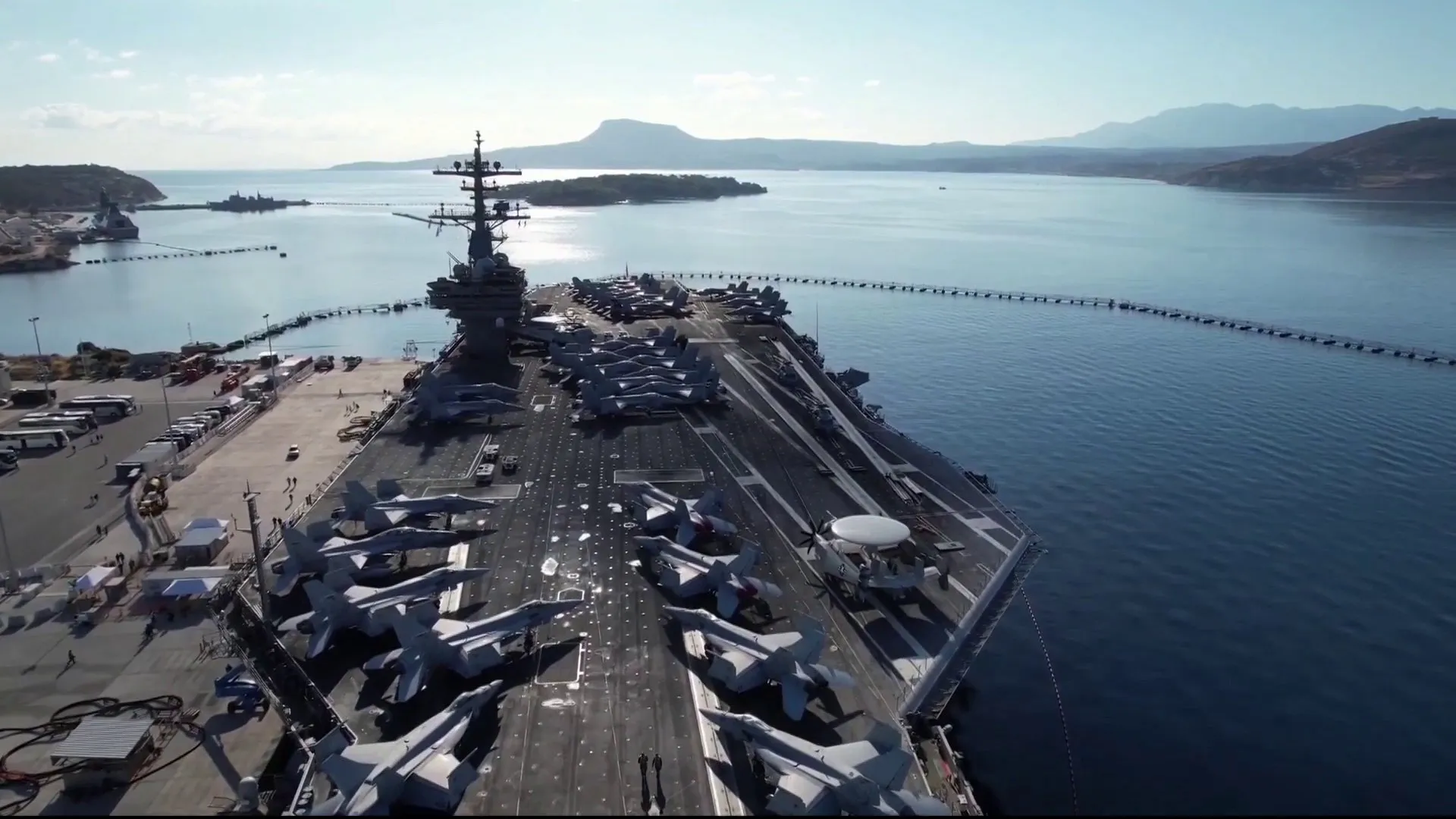
Washington has undertaken a radical shift in its military deployment strategy worldwide, a move analysts describe as a "military earthquake" that has not occurred in decades. This transformation aims to encircle Iran through the deployment of naval and aerial assets, reflecting a shift from traditional deterrence strategies to establishing new ground realities.
A report prepared by correspondent Ahmad Faldin for Al Jazeera highlights the dimensions of this unprecedented military buildup, with simultaneous movements observed in the Pacific, Atlantic, Europe, and East Asia, all converging towards one goal: tightening the noose around Iran by land, sea, and air.
Details of the Deployment
The movements began in the Pacific and the South China Sea, where the aircraft carrier USS Abraham Lincoln left the Seventh Fleet's area in January, creating a significant strategic void. The carrier has since settled near the southern entrances of the Strait of Hormuz and the Gulf of Oman.
By late March, the maritime encirclement was completed with the arrival of the amphibious group Tripoli from Japan, positioning itself at the Bab al-Mandab Strait, while the Boxer group moved from San Diego to bolster the presence in the Gulf of Oman.
In the air, Ovda Air Base in the Negev received 12 F-22 Raptor aircraft, marking the first offensive deployment of its kind in the region in years, as these planes will accompany the stealthy strategic bombers B-2 Spirit in any potential strike on Iran.
Additionally, 14 refueling aircraft were spotted arriving at Ben Gurion Airport, while AWACS planes monitored the airspace on extended reconnaissance missions. In a related context, squadrons of Strike Eagle aircraft moved from the British Lakenheath base to Muwaffaq Salti Air Base in Jordan and Israeli bases, with reports of F-16 Fighting Falcons departing from bases in Germany and Italy towards unspecified areas in the Gulf.
On the ground, the advance elements of the 82nd Airborne Division from Fort Liberty in North Carolina have arrived to join over 3,500 Marines in the Arabian Sea, with reports indicating the possibility of increasing the number to 17,000 soldiers, in addition to around 40,000 American troops already in the region prior to these reinforcements.
Background & Context
This massive buildup raises serious strategic questions, as the report noted that the withdrawal of the USS Abraham Lincoln from the South China Sea creates a "gap" in the deterrence wall against China, coinciding with increased Chinese naval activity around Taiwan. Russia may also exploit the withdrawal of the USS Gerald Ford from the Atlantic to gain advantages in Ukraine, benefiting from the American pivot towards the Iranian front.
It is noteworthy that the U.S. Department of Defense classifies China as a persistent and urgent threat, while Iran is categorized merely as a regional power, raising a pivotal question about whether the smaller threat has drained Washington's strategic compass away from the larger challenge looming at the edges of the scene.
Impact & Consequences
The U.S. military buildup around Iran could fundamentally alter the balance of power in the region, reflecting Washington's desire to enhance its military presence in the face of potential threats. This could lead to heightened tensions between the United States and Iran, increasing the likelihood of new conflicts in the region.
On the other hand, this buildup may affect U.S. relations with its allies in the region, as some may feel concerned about escalating military tensions. Furthermore, this move could provoke reactions from other regional powers, such as Russia and China, potentially complicating the geopolitical landscape.
Regional Significance
For the Arab region, this U.S. military buildup may have direct implications for security and stability. Neighboring Arab countries may feel increased tensions, prompting them to bolster their military capabilities or seek new alliances.
At the same time, this situation could increase pressure on Arab governments to address the growing security challenges, potentially affecting their internal stability.
In conclusion, the U.S. military buildup around Iran appears to be not just a military maneuver but part of a broader strategy aimed at reshaping the balance of power in the region, necessitating close monitoring by all concerned parties.