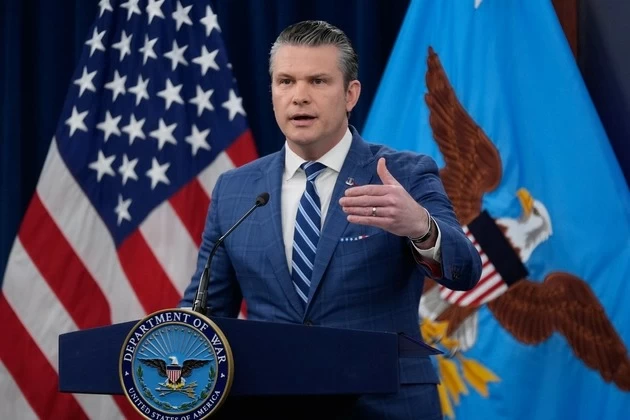
U.S. Secretary of Defense Pete Hegseth announced on Wednesday that American forces have achieved a "historic and overwhelming victory" over Iran. Hegseth confirmed that the U.S. military presence in the region will continue to ensure that the new Iranian leadership adheres to the terms of the temporary peace agreement between the two countries.
The remarks came during a press conference at the Pentagon, just hours after President Donald Trump announced a two-week ceasefire to pave the way for peace negotiations. Hegseth stated, "We will remain here; we are not going anywhere," adding that "our forces are ready to defend, ready to attack, and ready to resume operations at any moment using any necessary target package."
Details of the Event
Earlier, Trump posted on social media that the United States and Iran had agreed on several terms in an initial peace plan consisting of 15 points. Hegseth's optimism reflects a belief that the major military operation is nearing its end, as he referred to the operation "Epic Fury" in the past tense. This optimism contrasts with remarks from Vice President J.D. Vance, who described the situation in the Middle East as a "fragile truce" that could collapse in the coming days.
Hegseth expressed confidence in the continuation of the agreement, highlighting American military dominance over the past six weeks. He asserted, "In less than 40 days, using less than 10% of America's total combat power, we have destroyed one of the largest armies in the world and the foremost state sponsor of terrorism, proving Iran's complete inability to defend itself."
Background & Context
Iran is considered one of the largest military powers in the Middle East, and the United States has faced significant challenges in dealing with it. Since the beginning of military operations on February 28, American forces have targeted over 13,000 objectives, including the destruction of approximately 80% of Iran's air defense systems.
The military operations also included the destruction of over 1,500 air defense targets and 450 ballistic missile storage facilities, along with 800 offensive drones. General Dan Keen, Chairman of the Joint Chiefs of Staff, confirmed that the operations included more than 700 strikes on maritime mine targets in the Strait of Hormuz, reflecting the scale of the challenges Iran faces in this context.
Impact & Consequences
The United States expects that shipping lanes through the Strait of Hormuz, which accounts for about 25% of global crude oil trade, will be fully reopened under the terms of the ceasefire. The closure of the strait during the war led to a sharp rise in global energy prices, directly impacting the global economy.
Hegseth downplayed reports of ongoing attacks by Iranian proxies, asserting that they do not rise to the level of violating the peace agreement. However, he warned that "Iran would be wise to find a way to send a message to its forces in remote areas via a carrier pigeon," emphasizing that American forces remain ready for immediate response if necessary.
Regional Significance
This development reflects a significant shift in security dynamics in the Middle East, where Iran remains a key player. The continued U.S. military presence could affect regional balances and increase tensions among major powers.
In conclusion, the situation in the Middle East remains complex, with political and military interests intertwining. Close monitoring of upcoming developments is required, especially given the ongoing challenges faced by Iran.