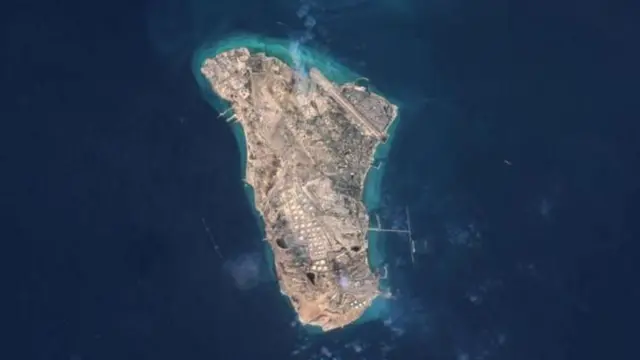
In a new escalation, the U.S. Central Command (CENTCOM) has announced an airstrike on Iran's Kharg Island, which President Donald Trump described as "one of the strongest airstrikes in Middle Eastern history." Trump confirmed that the strike completely destroyed all military targets on the island, which is considered the "jewel of the Iranian crown."
This airstrike comes at a time when U.S.-Iranian relations are increasingly strained, with both countries exchanging accusations regarding military activities and regional influence. Trump's statements have elicited mixed reactions from Iranian officials, who view these operations as a violation of their sovereignty.
Details of the Event
According to military sources, the airstrike was executed on March 13, targeting specific military sites on Kharg Island, which is regarded as a strategic center for Iranian operations in the Gulf. U.S. officials reported that the strike aimed to undermine Iranian military capabilities and enhance regional security.
The island, located in the Arabian Gulf, serves as a launch point for many Iranian maritime activities, including arms smuggling operations. The United States had previously included Kharg Island on its list of potential targets as part of its strategy to counter Iranian threats.
Background & Context
Historically, Kharg Island has been a focal point of regional conflicts, witnessing tensions between Iran and neighboring countries, including Gulf states. In recent years, Iranian military activities in the region have intensified, prompting the United States to bolster its military presence in the Gulf.
This airstrike is part of a broader strategy aimed at deterring Iran from expanding its influence in the region. Relations between Washington and Tehran have notably deteriorated since the U.S. withdrawal from the Iranian nuclear deal in 2018, leading to the imposition of severe economic sanctions on Iran.
Impact & Consequences
Analysts suggest that this airstrike could escalate tensions between the United States and Iran, increasing the likelihood of military conflicts in the region. Experts have warned that these operations may negatively impact regional security and provoke military responses from Iran.
Moreover, this airstrike could affect U.S. relations with its allies in the region, as some countries may feel apprehensive about U.S. military escalation. At the same time, Iran may leverage these events to strengthen its internal position and rally public support against what it perceives as American aggression.
Regional Significance
This airstrike signals a rise in tensions in the Gulf region, which is already suffering from instability. These events could have repercussions for Gulf Arab states, which rely on maritime security and free trade in the area.
Additionally, military escalation may lead to increased oil prices, impacting Arab economies that heavily depend on oil revenues. Under these circumstances, Arab countries may find themselves compelled to reassess their security and economic strategies to address new challenges.
In conclusion, the U.S. airstrike on Kharg Island emerges as a historic event that could reshape the contours of conflict in the region, reflecting the escalating tensions between major powers. The current situation requires close monitoring by the international community to avoid further escalation that could threaten regional and global security.