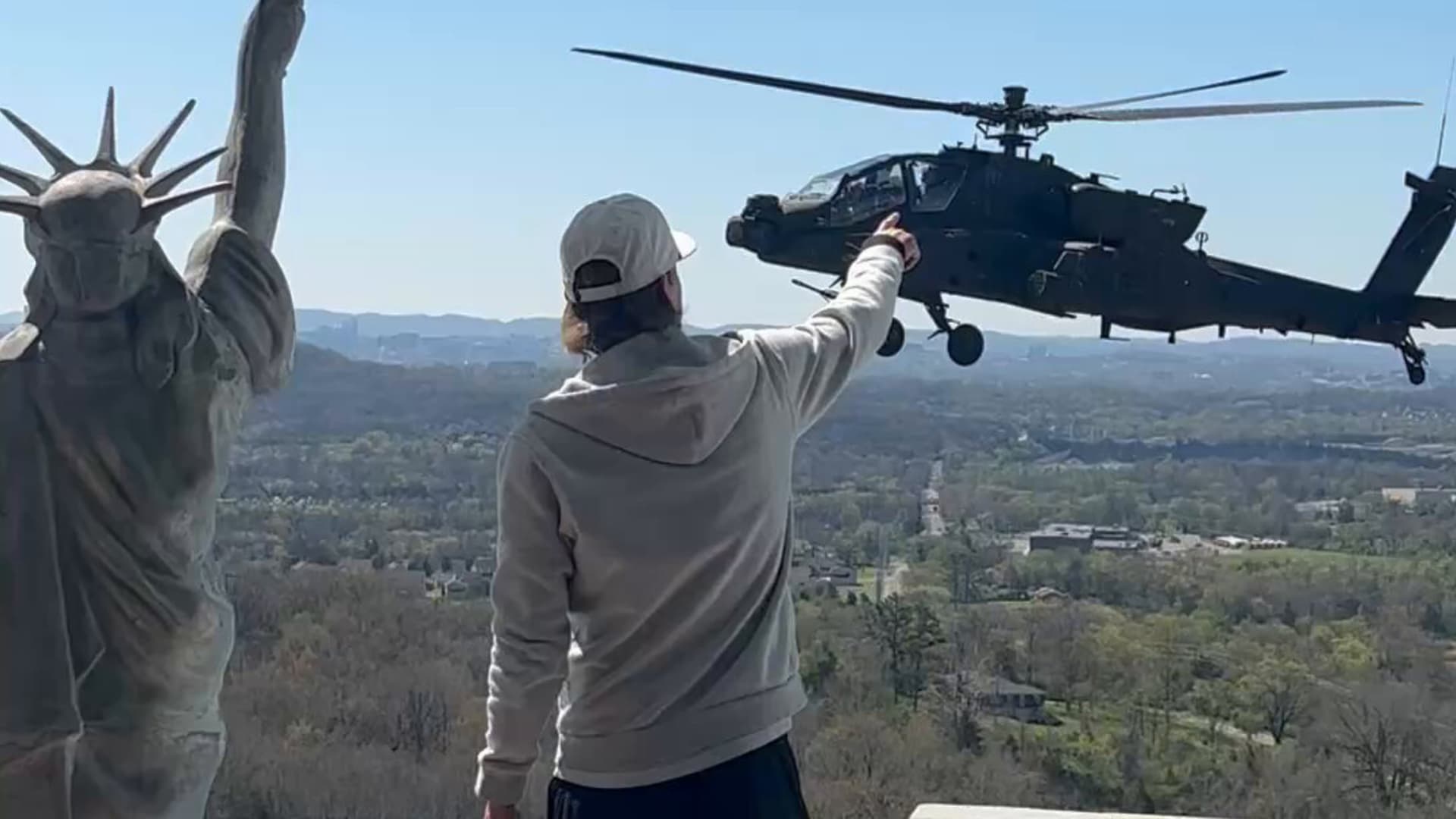
The US Army has confirmed that it is investigating the presence of Apache helicopters flying over the home of American singer Kid Rock in Nashville, during a day marked by protests against former President Donald Trump. The incident has generated significant controversy on social media, especially after Kid Rock posted videos showing the helicopters flying near his residence.
In the videos, Kid Rock is seen pointing at the helicopters and expressing his excitement, writing on his account on the platform 'X' (formerly Twitter) comments indicating his respect for the US military. He also criticized California Governor Gavin Newsom, a prominent Trump critic, stating, 'This is a level of respect that the dumb Governor of California will never know.'
Details of the Incident
US Army spokesperson Major Montrell Russell stated in an email that the Army is aware of the circulating video showing AH-64 Apache helicopters operating in a residential area in Nashville. He clarified that military pilots are required to adhere to strict safety standards, and an administrative review is underway to assess the mission and verify compliance with regulations and airspace requirements.
Russell noted that appropriate actions would be taken if any violations are found, and no further comments would be made until the review is complete.
Background & Context
Kid Rock is a prominent figure in the American entertainment scene, known for his strong support of former President Donald Trump. The incident comes at a sensitive time, as the United States witnessed protests on Saturday under the slogan 'No Kings,' expressing opposition to Trump and his policies. These protests are part of a broader movement challenging the political influence of former presidents and calling for radical changes in the political system.
Historically, there have been similar instances where military aircraft were used in unconventional contexts, raising questions about the proper use of military force in civilian airspace. This incident may spark discussions about the boundaries between national security and individual rights.
Impact & Consequences
This incident could lead to legal and administrative repercussions within the US Army, as any violation of standards could result in deeper investigations and disciplinary actions. Additionally, this event may contribute to heightened tensions between Trump supporters and opponents, especially in the current politically charged atmosphere in the country.
Moreover, this incident could affect the image of the US Army, which is viewed as a symbol of security and stability. Any potential violation of standards could undermine public trust in the armed forces.
Regional Significance
Considering the events in the United States, such incidents may influence how Arab nations perceive the US and its political system. Internal tensions in the US could impact its foreign policy, including relations with Arab countries.
Furthermore, incidents involving the use of military force in civilian airspace may raise concerns in Arab nations experiencing political tensions, as they could be used as tools for pressure or control over protests.
In conclusion, this incident remains an example of the challenges facing American democracy and how it can affect international relations, including those with the Arab world.