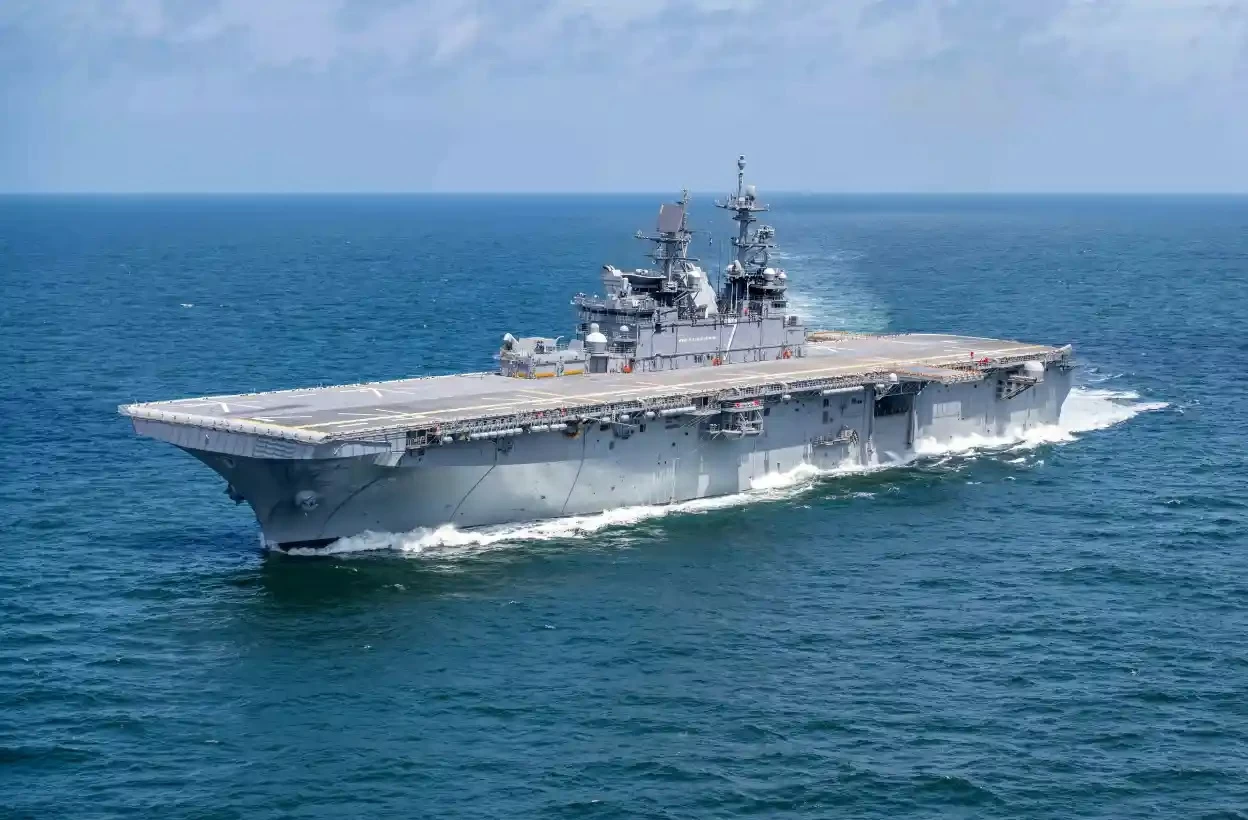
The US Central Command, known as Centcom, denied today (Monday) the Iranian Revolutionary Guard's claims regarding an attack on the amphibious assault ship USS Tripoli by missiles. The US command confirmed via its official account on the platform X that these statements are inaccurate, emphasizing that the ship has not been attacked and is continuing its missions in the Arabian Sea.
The USS Tripoli, which belongs to the class of American ships, operates as a command vessel for the Tripoli Amphibious Ready Group, which includes approximately 3,500 sailors and Marines, along with transport aircraft and attack fighters. The ship is participating in a military operation known as Operation Epic Fury.
Details of the Incident
These statements come at a sensitive time, as the Iranian Revolutionary Guard had announced targeting the USS Tripoli, prompting it to withdraw to the southern Indian Ocean. However, the US command confirmed that the ship remains in the operational area, reflecting the ongoing tensions between the United States and Iran in the region.
Former US President Donald Trump had previously indicated that he preferred imposing transit fees on the Strait of Hormuz rather than Iran, suggesting that "spoils go to the victor" in reference to the ongoing conflict over Iranian oil. Trump also criticized US allies such as NATO, Australia, Japan, and South Korea for not providing sufficient support against Iran.
Background & Context
Tensions in the Arabian Gulf are escalating, with Iran playing a pivotal role in regional conflicts. Recently, there has been an increase in military activities between the United States and Iran, raising the risks of direct confrontations. The USS Tripoli is part of the US strategy to bolster its military presence in the region, especially in light of ongoing Iranian threats.
In this context, Axios reported that Trump assured Israeli Prime Minister Benjamin Netanyahu that he would not abandon the delivery of enriched uranium to Iran, indicating his readiness to cease fire if Iran agrees to his terms. Netanyahu warned of the dangers of a ceasefire at this time, reflecting Israeli concerns over escalating Iranian activities.
Impact & Consequences
These events indicate a rise in tensions in the Gulf region, where any military confrontation could have serious repercussions for regional and international security. The continuation of US military operations in the area may heighten Iranian provocations, threatening the stability of the region.
Any escalation in the conflict between the United States and Iran could directly affect global oil prices, as the Strait of Hormuz is one of the most important maritime routes for oil trade. Additionally, these tensions may impact relations between the United States and its allies in the region, particularly given Trump's criticisms of Washington's partners.
Regional Significance
Developments in the Arabian Gulf significantly affect neighboring Arab countries, where any military escalation could lead to an influx of refugees and increased internal tensions in some states. Arab nations may find themselves compelled to take decisive stances amid these tense circumstances.
In conclusion, events in the Arabian Gulf remain under the world's spotlight, as everyone closely monitors the developments of the conflict between the United States and Iran and its impact on security and stability in the region.